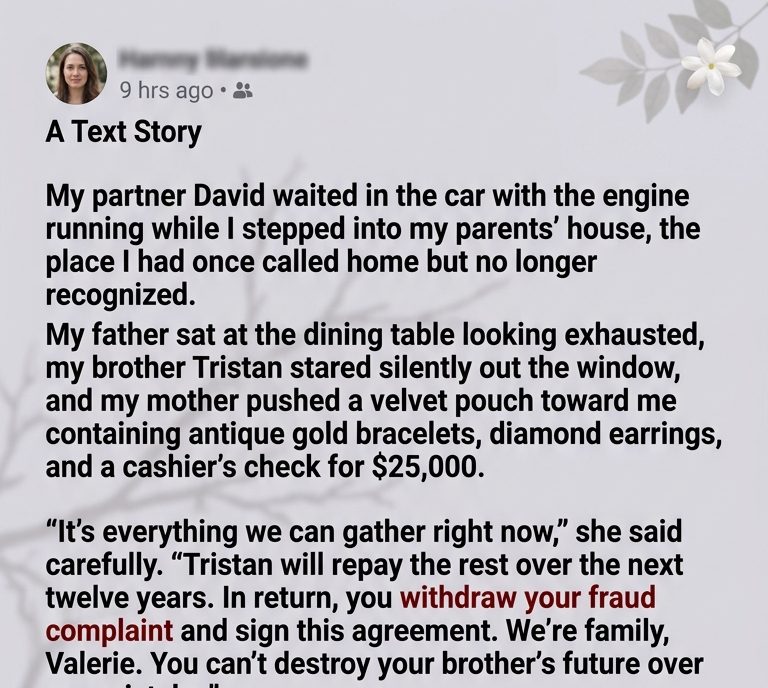
My partner, David, waited in the driveway with the engine running while I walked into my parents’ house, the same house where I had spent my childhood believing that family meant loyalty, honesty, and unconditional love. That afternoon, it felt more like a courtroom where everyone had already decided I was the villain.
My father, Robert, sat at the dining table with his shoulders slumped. My mother, Diane, stood beside him, nervously twisting her wedding ring. My older brother, Tristan, leaned against the window, avoiding my eyes.
Between them sat a velvet pouch, a cashier’s check for $25,000, and a stack of legal documents.
My mother pushed everything toward me.
“This is what we could gather quickly,” she explained. “The bracelets belonged to your grandmother. The earrings were mine. Your father has agreed to sell some investments, too.”
I stared at the check.
Twenty-five thousand dollars.
That was less than a third of what Tristan had stolen using my professional credentials, forged documents, and personal information. For months, he had impersonated me to obtain contracts and financial approvals. When the truth surfaced, the damage had spread across several companies, and investigators were already examining the evidence.
Now my family wanted me to make it disappear.
“Tristan will repay the remaining amount over twelve years,” my mother continued. “He’ll sign a repayment agreement. You withdraw the fraud complaint, and we can all move forward.”
Tristan finally turned from the window.
“I made a stupid decision,” he muttered. “I never meant for it to get this bad.”
I had heard variations of that sentence my entire life.
When he crashed my first car at nineteen, he had made a stupid decision.
When he borrowed money from relatives and never repaid them, he had been going through a difficult time.
When he lost jobs, broke promises, and blamed everyone around him, my parents had always found a reason to protect him.
But this time, he had used my identity to deceive people who trusted my work. My reputation, my career, and my financial security had become collateral for his lies.
“This wasn’t a mistake, Mom,” I said. “He spent months planning it. He forged credentials and used my professional information to obtain more than $90,000.”
My mother’s eyes filled with tears.
“He’s your brother.”
“And I’m your daughter.”
The room fell silent.
I reached into my pocket and took out the brass key to my parents’ house. I had kept it for years, even after I stopped visiting regularly. Once, it had represented the comfort of always having somewhere to return.
I placed it on top of the cashier’s check.
“Keep the jewelry. You’ll need it for his legal fees.”
My mother went pale.
Tristan swore under his breath and shoved his chair backward.
“You’re seriously going to destroy my life over money?”
I looked directly at him.
“No. You put your own future at risk when you decided my name was something you could steal.”
I stood to leave.
Then my father spoke.
“Valerie, sit down.”
There was something in his voice I had never heard before. Not anger. Not disappointment. Fear.
“There’s something you don’t know about the money Tristan took.”
He slid another document across the table.
I almost ignored it. I had spent enough years listening to my family invent excuses for Tristan. But when I glanced at the first page, I recognized the name of a company I had never done business with.
Then I saw my own signature.
Or something that looked remarkably like it.
“What is this?” I asked.
My father closed his eyes.
“It started long before the money disappeared.”
I slowly sat back down.
And for the first time that afternoon, my mother stopped crying.
Three months earlier, I had received a call from a compliance officer at a financial services firm. She wanted to verify a professional credential associated with my name.
At first, I assumed it was a routine inquiry.
Then she mentioned a consulting contract worth $38,000 that supposedly carried my approval.
I had never seen the contract.
Over the following week, more questions arrived. A second company had received documents listing me as a financial adviser. Another had been given authorization forms bearing my signature. Someone had used my résumé, professional identification, and employment history to make the paperwork appear legitimate.
I reported the matter immediately.
The evidence pointed toward Tristan.
He had obtained copies of my old documents during a family visit. I had left a folder in my home office while helping my parents organize their finances, and he had offered to scan some paperwork for me.
I remembered thanking him.
That memory became almost unbearable after investigators found altered versions of the documents on a device connected to him.
At first, Tristan denied everything.
Then he claimed someone else had used his computer.
Finally, when confronted with messages and financial records, he admitted that he had submitted false documents. He insisted the money had gone toward a business venture that was supposed to make him rich enough to repay everyone.
The venture had failed.
The money was gone.
And my name was attached to the damage.
My parents responded exactly as I had feared. They called me privately, telling me that Tristan was frightened and that the family needed to handle things quietly.
My mother said the companies might be willing to settle.
My father said a criminal investigation could follow Tristan for the rest of his life.
Neither asked how I was sleeping. Neither asked whether my employers still trusted me or whether I had spent nights worrying that one forged document could undo years of professional work.
They asked when I planned to withdraw my complaint.
David was the only person who told me I did not owe anyone an answer.
“You can love your family without taking responsibility for what they do,” he said one evening as we sat at our kitchen table.
I knew he was right.
I just hadn’t understood how much I would lose by acting on it.
Back in my parents’ dining room, I turned the document toward the light.
It was an agreement involving a company called Northbridge Holdings, dated nearly eight years earlier. My name appeared beneath the title of authorized representative.
The signature was unmistakably forged.
But it was the second page that made my stomach tighten.
The agreement referenced a business account funded by an inheritance from my grandmother, Margaret.
I remembered that inheritance. When she died, my parents told me that most of her money had been consumed by medical expenses and outstanding debts. They said there had been very little left after settling everything.
I had been twenty-four at the time, overwhelmed with work and too trusting to question their explanation.
According to this document, however, a substantial portion of the estate had been placed into an investment account under Northbridge Holdings.
The account had been used to finance a small property portfolio.
And the original beneficiary was listed as me.
I read the line again.
“Why is my name on this?”
My father rubbed his face with both hands.
“Your grandmother wanted to leave you something secure. She knew you were responsible, and she wanted you to have a foundation of your own.”
“How much?”
He hesitated.
“How much, Dad?”
“Approximately four hundred and twenty thousand dollars, including the initial investments.”
For a moment, I couldn’t hear anything but the hum of the refrigerator.
Four hundred and twenty thousand dollars.
My grandmother had not left me a small inheritance that disappeared into medical bills. She had left me enough to build a future.
And my parents had never told me.
I turned toward my mother.
“Did you know?”
She looked down at her hands.
“Yes.”
The answer was so quiet that I almost wished I hadn’t heard it.
“Why?”
“Your father was trying to help Tristan,” she whispered. “He had debts. His first business was failing. We thought we could use part of the money temporarily, then replace it before you ever needed it.”
“Part of it?”
My father stared at the document.
“We used some of the investment returns to cover his debts. Then the property business became more complicated. We borrowed against assets connected to the company. There were taxes, fees, and payments we couldn’t keep up with.”
I felt cold.
“You told me the inheritance was gone.”
“We thought we could put everything back,” my mother said. “Every time we got close, something else happened.”
“Then you let me believe my grandmother left me almost nothing.”
“We were ashamed.”
“No,” I said. “You were comfortable letting me believe it because the truth would have forced you to stop.”
Tristan had gone completely still.
For the first time since I arrived, he looked less angry than frightened.
I returned to the document.
A series of transactions showed that money had moved through the company over several years. Some transfers appeared to have been made for legitimate property expenses. Others were described as loans to Tristan or payments to companies I did not recognize.
Several records carried my forged authorization.
The most recent transfers were the ones that had triggered the current investigation.
Tristan hadn’t merely stolen money from outside businesses using my credentials. He had also used my identity to support transactions connected to a financial structure my parents had concealed from me.
My fraud complaint had exposed the arrangement.
“What did he take from this account?” I asked.
My father swallowed.
“About one hundred and eighty thousand dollars over time. We can’t account for all of it.”
My mind raced through the numbers. The original inheritance had been around $420,000. If the investment portfolio had grown, then later losses and unauthorized transfers could mean the true value was far higher than what remained.
“Who owns the properties now?”
“Northbridge does,” he answered. “At least, the company owns most of them. One property was sold. There are outstanding loans.”
“And who controls Northbridge?”
My father didn’t answer.
I looked back at the first page.
The company had been registered in my name as its original beneficiary, but the documents did not establish that I had personally managed it or approved its later transactions. The difference mattered. A name on a form did not automatically resolve ownership, and a forged signature did not make a transaction legitimate.
Still, I could see why my parents had panicked when the investigation began.
They were afraid that the records would reveal not only Tristan’s fraud, but years of financial decisions they had hidden from me.
I gathered the pages into a neat stack.
“Have you given all of this to the investigators?”
My father looked away.
“Not yet.”
“Then you need to.”
My mother reached for my hand.
“Valerie, please. We can fix this together. We can get an attorney, arrange a proper repayment plan, and explain that your father and I were trying to protect everyone.”
I pulled my hand back.
“You don’t get to call it protection when you hid my inheritance, allowed Tristan to use my identity, and waited until an investigation forced you to tell me.”
Her face crumpled.
My father looked older than he had an hour earlier.
“We never wanted to hurt you.”
I believed that they might have started with good intentions. Perhaps they had told themselves that every secret was temporary, every transfer would be repaid, every new lie would buy them enough time to make the previous one disappear.
But intentions did not erase the consequences.
“You should have told me years ago,” I said. “You should have told the truth before you asked me to sacrifice anything else.”
I put the documents into my bag.
Then I stood.
“I’m not withdrawing the complaint. I’m not signing your agreement. And I’m not accepting money or jewelry in exchange for silence.”
My mother stared at me as if I had spoken a foreign language.
“Where are you going?”
“Home.”
I walked toward the front door.
This time, I did not look back at the photographs on the wall or the hallway where my brother and I used to race each other as children. I did not take the family portrait from the shelf or stop to explain why I was leaving.
David was waiting exactly where I had left him.
When I got into the passenger seat, he studied my face.
“What happened?”
I held the folder against my chest.
“They didn’t just hide Tristan’s fraud. They hid my inheritance for years.”
David’s expression changed, but he didn’t interrupt.
“They told me it was gone. It wasn’t. They used it to cover his debts and build a business I never knew existed.”
He reached across the console and took my hand.
“Are you okay?”
“No,” I admitted. “But I know what I need to do.”
For the first time that day, the answer felt true.
The following morning, I contacted an independent attorney who had no connection to my family. I brought every document my father had given me, along with the evidence I had already collected regarding Tristan’s forged credentials.
My attorney listened without interrupting. Then she separated the problem into three parts: the fraud investigation, the question of who legally owned the inheritance and related assets, and the possibility that my parents had misrepresented transactions over several years.
She made one thing clear.
The documents needed to be verified. The account history had to be reconstructed. Property titles, company records, loan agreements, and estate paperwork would have to be reviewed before anyone could say exactly what remained or who had a legal claim to it.
There would be no instant recovery and no magical signature that returned everything overnight.
But there was a path toward the truth.
We arranged for the relevant records to be preserved and submitted through the appropriate legal channels. I also notified my employer’s compliance department and followed their instructions for documenting the unauthorized use of my professional information.
The next several weeks were exhausting.
I answered questions from investigators. I supplied samples of my signature. I reviewed documents I had never seen before, each one carrying a small piece of my identity that someone else had tried to control.
Tristan’s attorney eventually confirmed that his client would cooperate with the investigation. That did not erase what he had done, and it did not guarantee what legal consequences he would face.
The family agreement my mother had prepared was never signed.
The cashier’s check was never deposited.
The jewelry stayed with my parents.
Meanwhile, the financial review uncovered more records connected to Northbridge Holdings. Some transactions were supported by property expenses and existing loan agreements. Others lacked the authorization my parents had claimed existed. The investigation began examining those discrepancies separately from Tristan’s original fraud.
My parents could no longer treat the matter as a private disagreement between siblings.
There were records, financial institutions, and other people whose money and trust had been affected.
For the first time, the consequences could not be negotiated away over dinner.
Two months later, my father called me.
I almost let it go to voicemail.
Instead, I answered and listened.
“I’ve given the investigators the records they requested,” he said. “Your mother and I have hired our own attorney. We’re cooperating with the review.”
I waited.
“I should have told you about your grandmother’s money. I should have protected your name instead of letting Tristan use it. And I should never have asked you to withdraw the complaint.”
It was the closest thing to an honest apology I had heard from him in years.
“Why did you keep going?” I asked.
He took a long breath.
“Because every time we thought we could fix it, telling you the truth became harder. We were afraid you’d see what we’d done and never forgive us.”
“You were more afraid of my reaction than of what you were doing to me.”
He did not argue.
That silence told me more than any excuse could have.
My mother sent a letter a week later. She wrote about my grandmother, about the day the inheritance documents arrived, and about the promises my parents had made to themselves when they first used the money.
She admitted that she had spent years telling herself the family was only borrowing from me, even after she knew I had never agreed to it.
At the end, she wrote, I kept asking you to save your brother because I was afraid of losing him. I never stopped to consider that I was asking you to lose yourself.
I read the sentence several times.
It did not make everything right. It did not restore the money or erase the betrayal. But it was the first time my mother had acknowledged that her loyalty to Tristan had come at my expense.
I did not rush to forgive her.
I simply put the letter away.
By the end of the year, the financial review had clarified the ownership structure and identified which transactions could be challenged. Some assets were tied to outstanding loans, and recovering money would require further legal work. Other records supported my claim to a portion of the remaining inheritance.
The process was slow, expensive, and frustrating.
But it was real.
I also learned something about Tristan that made the situation even more complicated: he had not been the only person benefiting from the hidden arrangement. My parents had used money from the portfolio to cover household expenses and debts of their own. They had not set out to steal my future in one dramatic act. They had taken pieces of it over years, each time convincing themselves that the next payment would make everything right.
That truth hurt more than I expected.
It would have been easier if one person had been responsible for everything. Instead, I had to accept that the people who loved me had also made choices that harmed me—and that love did not make those choices harmless.
Tristan eventually sent me a message.
He apologized for forging my credentials and using my identity. He admitted that he had expected our parents to persuade me to forgive him, just as they always had.
“I thought you’d eventually give in,” he wrote. “I never considered what it would cost you.”
I did not respond immediately.
When I finally did, I told him that any repayment or legal resolution would have to happen through the proper channels. I would not negotiate privately, and I would not promise forgiveness in exchange for cooperation.
He accepted that answer.
It was the first time he had ever done so without trying to change my mind.
Nearly a year after the day I placed my house key on the cashier’s check, David and I sat on the balcony of our apartment watching the evening light fade over the city.
I had stopped keeping the brass key on my key ring. It now rested in a small drawer beside the letters my grandmother had written me when I was younger.
I hadn’t thrown it away.
I wasn’t ready to pretend my childhood had been entirely unhappy or that every memory of my family was false. There had been birthdays, ordinary dinners, and moments of genuine tenderness. Those memories belonged to me, too.
But I no longer mistook history for an obligation to accept whatever my family demanded.
My parents and I had begun speaking again, cautiously and infrequently. I made it clear that any relationship we rebuilt would have to rest on honesty, not guilt. They could not ask me to conceal records, pressure investigators, or protect Tristan from consequences.
My mother respected those limits, though she sometimes struggled with them.
My father began sending updates through my attorney rather than expecting me to manage his anxiety. It was a small change, but it mattered.
Tristan still had a long road ahead of him. So did my parents. And so did I.
The inheritance had never been the only thing taken from me. There was the trust I had placed in my family, the time I had spent doubting myself, and the belief that being a good daughter meant being endlessly forgiving.
Those things could not be restored by a check.
They could only be rebuilt, if they were rebuilt at all, through choices made differently over time.
One evening, I opened my grandmother’s last letter. She had written it shortly before she died, telling me that she hoped I would use what she left me to create a life where I never had to depend on someone else’s permission to feel secure.
I had always assumed she meant money.
Now I understood that she had meant something larger.
The inheritance was supposed to give me a foundation, not a reason to keep rescuing people who refused to change.
I folded the letter carefully and placed it back in its envelope.
Then I closed the drawer.
I had not destroyed my brother’s future by refusing to withdraw the complaint. I had stopped allowing him, and everyone who enabled him, to gamble with mine.
And when I finally walked away from my parents’ dining table that afternoon, leaving the jewelry and the check behind, I had not abandoned my family.
I had simply refused to let family become another name for silence.