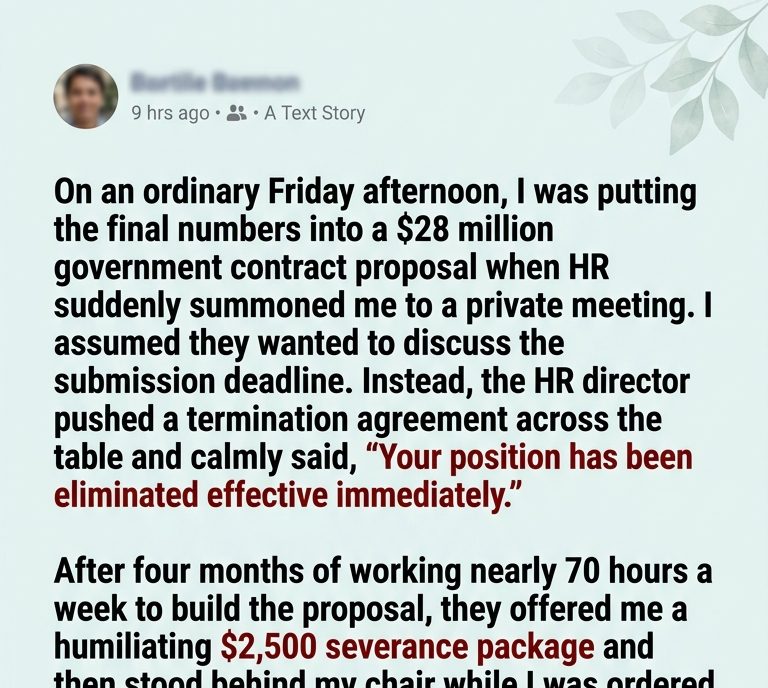
The termination meeting lasted eleven minutes.
Four months of my life disappeared in less than a quarter of an hour.
I had spent nearly seventy hours a week preparing a $28 million government contract proposal for my company. I had built the forecasting model, checked the labor assumptions, reviewed vendor pricing, reconciled historical performance, and spent countless nights making sure every number could survive an audit.
That Friday afternoon, I was entering the final figures when HR emailed me.
Please come to Conference Room B immediately.
I assumed it was about the proposal.
Instead, the HR director was sitting beside the vice president of finance.
There was a folder on the table.
“Please sit down,” she said.
I knew immediately.
Still, I asked.
“What’s this about?”
She pushed the folder toward me.
“Your position has been eliminated effective immediately.”
I stared at her.
“I’m sorry?”
“The company is restructuring.”
“Today?”
“Yes.”
“The proposal is due Monday.”
She looked away.
“That’s not your concern anymore.”
I almost laughed.
For four months, the proposal had been my concern.
I had canceled vacations.
Missed birthdays.
Worked weekends.
Answered emails at two in the morning.
I had even slept in the office twice because we were behind schedule.
Now they were telling me I wasn’t needed.
The vice president slid another paper across the table.
“Your severance is $2,500.”
I looked at the number.
After four months of sixty-to-seventy-hour weeks?
$2,500.
“Is this negotiable?”
“No.”
Then came the part that hurt most.
They stood behind me while I logged into my company computer.
“Please delete all project files.”
I looked at the screen.
Years of work.
Four months of the most important project of my career.
Gone.
I didn’t argue.
I didn’t threaten them.
I didn’t beg.
I deleted what they told me to delete.
Then I emptied the recycle folder.
I shut down the computer.
I stood up.
“Anything else?”
The HR director shook her head.
I picked up my bag.
“Have a good weekend.”
Nobody answered.
I walked out.
But there was something they didn’t know.
The spreadsheet on that computer wasn’t the proposal.
It was only the visible layer.
Months earlier, because the project involved sensitive financial forecasting, I had created a private encrypted archive containing my original working models.
Not company documents.
Not confidential files.
My own analytical framework.
The formulas.
The methodology.
The scenario architecture.
The assumptions I had personally developed.
I kept it separate because I didn’t trust the company’s internal storage after an earlier security incident.
I had never imagined that decision would matter.
Until Saturday morning.
At 8:14 a.m., my phone rang.
It was the CEO.
I almost didn’t answer.
Then I did.
“Hello?”
There was silence.
Then his voice.
“We need to talk.”
I smiled.
“I thought my position was eliminated.”
“It was.”
“So why are you calling me?”
His voice sounded exhausted.
“Something has gone terribly wrong with the proposal.”
I said nothing.
He continued.
“The numbers don’t reconcile.”
“What numbers?”
“The pricing model.”
I leaned back.
“Which one?”
“The one you built.”
I almost laughed.
“That sounds like a company problem.”
“It is.”
“Then you should probably talk to the people who replaced me.”
Another silence.
“They can’t fix it.”
“Why not?”
“Because they don’t understand how the model works.”
I looked out the window.
“That’s unfortunate.”
He lowered his voice.
“We need you.”
“No.”
“Please.”
I almost felt sorry for him.
Almost.
“What happened?”
He explained.
After I was fired, the company had assigned the proposal to another team.
They had opened the spreadsheet and discovered that several of the formulas were dependent on supporting calculations that weren’t included in the visible workbook.
They had assumed something was missing.
Then they tried rebuilding the calculations.
Their numbers didn’t match.
They had changed labor assumptions.
That altered overhead.
Which changed indirect costs.
Which changed pricing.
Which affected the bid’s projected margins.
They were now millions apart from the original model.
And the submission deadline was less than forty-eight hours away.
“Can you fix it?” the CEO asked.
I smiled.
“Maybe.”
“Come in Monday morning.”
“No.”
“Name your price.”
“No.”
He sighed.
“Then what do you want?”
I thought about the termination room.
The $2,500.
The way they had stood behind my chair while I deleted months of work.
“I want my employment agreement reviewed by an attorney.”
He went quiet.
“What?”
“You heard me.”
I had already contacted an employment lawyer that morning.
Not because I wanted revenge.
Because I wanted to understand exactly what the company believed it had the right to take from me.
My lawyer reviewed my employment agreement.
Then he asked me something.
“Did they instruct you to delete the files?”
“Yes.”
“Did you?”
“Yes.”
“Did they ask you to destroy your personal analytical archive?”
“No.”
“Did you use company equipment to create it?”
“No.”
“Did you use company time?”
“Some of the underlying research was done at work.”
He nodded.
“Then we need to be careful about what belongs to whom.”
That was exactly what I wanted.
No threats.
No dramatic accusations.
Just clarity.
On Monday morning, the CEO called again.
“We have a serious problem.”
“I know.”
“The government procurement officer requested clarification.”
“About?”
“The pricing.”
I didn’t answer.
“They think our proposal contains inconsistent cost assumptions.”
I closed my eyes.
I knew exactly what had happened.
My replacement team had modified the model without understanding the dependency structure.
The visible spreadsheet was never designed to be edited independently.
They had changed three assumptions.
Those three changes had cascaded through the model.
The final bid was now internally inconsistent.
“What do you want me to do?”
“Come back.”
“Under what terms?”
“We’ll reinstate your position.”
I laughed.
“After firing me?”
“We made a mistake.”
“No.”
I paused.
“You made a decision.”
He didn’t respond.
“Now you’re dealing with the consequences.”
He said:
“How much?”
I named a number.
He agreed immediately.
That surprised me.
Then I added:
“Independent authority over the financial model.”
“Agreed.”
“Written protection against retaliation.”
“Agreed.”
“And my attorney reviews everything.”
“Fine.”
I went back.
But I didn’t walk into the office as the same employee who had left three days earlier.
This time, everything was documented.
I brought my attorney’s letter.
I brought copies of my private methodology.
And I brought one more thing.
A printed page showing the exact moment the model had broken.
The CEO looked at it.
“Can you fix it?”
“Yes.”
“How long?”
“Six hours.”
It took me five.
The problem was exactly what I expected.
The replacement team had changed the labor escalation assumption from 4.2% to 2.8%.
That looked harmless.
But the model used labor escalation to calculate several downstream costs.
When they changed the figure, they manually adjusted other values to make the totals look reasonable.
That created inconsistencies.
The result was a proposal that appeared competitive but couldn’t survive detailed review.
I restored the proper assumptions.
Rebuilt the formulas.
Added validation checks.
And documented every change.
Then I handed the file to the CEO.
“Submit this.”
He looked at the model.
“Are we back to the original numbers?”
“No.”
He looked confused.
“Why not?”
“Because I found another problem.”
“What?”
“Your vendor pricing.”
He stared at me.
“The vendor quotes are six months old.”
“That’s what procurement gave us.”
“They’re outdated.”
I showed him the emails.
One supplier had raised prices by nearly 8%.
Another had changed delivery terms.
If the company submitted the old numbers, they could win the contract and then lose millions fulfilling it.
The CEO stared at the screen.
“How did you find this?”
“I called the vendors.”
He sat back.
For the first time, he looked less like a CEO and more like a man realizing how close he had come to a disaster.
“You saved us.”
“No.”
I shook my head.
“I prevented you from submitting a proposal that shouldn’t have been submitted.”
He looked at me.
“What’s the difference?”
“The difference is that I don’t want credit for fixing a problem you created.”
He nodded slowly.
The government proposal was eventually submitted with corrected numbers and complete documentation.
Weeks later, the company was informed that it had advanced to the next stage.
But the story didn’t end there.
My attorney discovered that the company had made several statements during my termination that weren’t consistent with the internal records.
They had claimed my position was eliminated.
Yet, within hours of firing me, they had posted a job listing for a nearly identical role.
They had also reassigned portions of my responsibilities to another employee.
That didn’t automatically prove wrongdoing.
But it raised questions.
The company eventually settled with me.
The settlement was significantly larger than the original $2,500.
I didn’t return permanently.
Instead, I negotiated a short consulting agreement to complete the procurement process.
Then I left.
A month later, I started my own consulting company.
My first client was a company that had once competed against my former employer.
I told them exactly what I did.
“I build financial models that people can understand and audit.”
They hired me.
Within a year, I had more clients than I could handle.
One afternoon, my former CEO called again.
“I heard you’re doing well.”
“I am.”
“I’m happy for you.”
There was a pause.
Then he said:
“We should have treated you differently.”
I looked at the framed copy of my first consulting contract hanging on the wall.
“Yes.”
He sighed.
“Would you ever come back?”
I smiled.
“No.”
“Why?”
“Because you taught me something.”
“What?”
“Never confuse being needed with being valued.”
He didn’t answer.
I ended the call.
The $28 million proposal eventually became one of the company’s biggest contracts.
But I wasn’t there when they signed it.
I was sitting in my own office, working on a proposal for my own company.
The funny thing is, I never regretted deleting those files.
They thought deleting the files meant deleting my value.
It didn’t.
The real value was never the spreadsheet.
It was the four months of knowledge behind it.
The reasoning.
The experience.
The ability to see what the numbers were actually saying.
And that was something no HR director could delete with a keyboard.
They gave me $2,500 and told me my position had disappeared.
Less than forty-eight hours later, their CEO called me because he discovered something much more expensive than my salary:
He had fired the one person who understood the numbers keeping his $28 million proposal alive.
And by the time he realized it, I had already walked away.