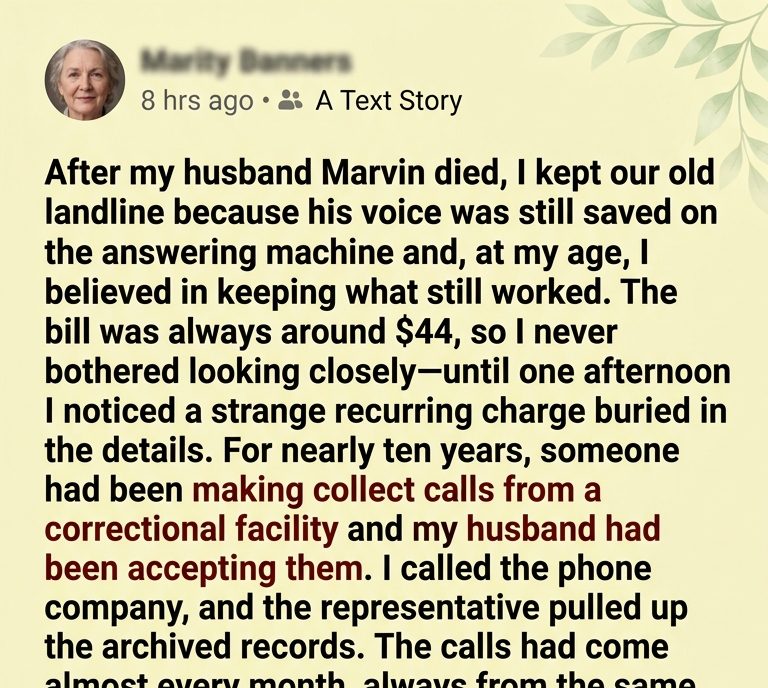
After my husband Marvin died, I kept our old landline for one simple reason: his voice was still saved on the answering machine.
It was one of those old machines with a tiny display and a cassette inside.
Every now and then, when I missed him badly enough, I would press play.
“Hi, sweetheart. It’s me. I’ll be home around six.”
That was Marvin.
Not the voice I remembered from photographs.
Not the voice I heard in dreams.
His actual voice.
Alive.
Warm.
Impatient about traffic.
As long as that machine worked, I couldn’t bring myself to disconnect the phone.
The bill was always around $44 a month, so I never examined it closely.
Then one afternoon, I was sorting through my expenses when I noticed something strange.
There was a recurring charge buried beneath the ordinary phone fees.
It wasn’t large.
But it appeared again and again.
Collect Call Services.
I stared at it.
Then I looked at the dates.
The charges went back years.
Almost ten years.
I called the phone company.
The representative placed me on hold.
When she returned, her voice had changed.
“Mrs. Bennett, these calls were coming from a correctional facility.”
I sat down.
“What?”
“They were collect calls.”
“Who was calling?”
“We can’t provide the caller’s identity over the phone, but I can tell you they came from the same facility.”
“How often?”
“Usually once a month.”
I looked at the old answering machine.
“Did my husband accept them?”
“Yes.”
My hands went cold.
Marvin had been accepting calls from prison for nearly a decade.
And I had never known.
Then the representative said something even stranger.
“The last accepted call was just a few weeks before your husband passed away.”
I couldn’t speak.
“And after that,” she continued, “there were thirteen unanswered attempts.”
“Thirteen?”
“Yes.”
“From the same facility?”
“Yes.”
Then suddenly, the calls stopped.
I stared at the phone.
Someone had been trying to reach my house over and over.
After Marvin died, they had tried thirteen more times.
And I had never known who they were.
The Number In The Records
My husband had never been secretive about ordinary things.
He wasn’t the kind of man who disappeared for hours without explanation.
He worked as a city electrician for thirty-six years.
He came home for dinner.
He watched baseball.
He complained about grocery prices.
He loved our grandchildren.
We had been married for forty-eight years.
There were no mysterious years of his life that I knew about.
At least, I thought there weren’t.
I called our neighbor, Mrs. Alvarez.
Her son Daniel was a public defender.
I told her what I had discovered.
She was quiet.
Then she said:
“Mom, don’t panic.”
“I don’t know how not to.”
“I’ll ask Daniel what can legally be done.”
Two days later, Daniel came over.
He was careful with his words.
“Your husband receiving calls from someone in prison doesn’t necessarily mean he was involved in anything.”
“I know.”
“But if you want to find out who it was, there are procedures for requesting certain records.”
“Can we find out?”
“Maybe.”
He helped me prepare the paperwork.
I didn’t know what I expected.
A former coworker?
An old friend?
Someone Marvin had helped?
Maybe even a person who had the wrong number.
But none of those possibilities explained ten years of regular calls.
Three weeks later, an envelope arrived.
Inside was a visitor approval.
And a name.
Thomas Reed.
I didn’t recognize it.
Underneath was the correctional facility’s information.
Daniel looked at me.
“Do you want to go?”
I stared at the paper.
“Yes.”
The Man Behind The Calls
Saturday morning, I wore my best blue dress.
I don’t know why.
Maybe because I wanted to look respectable.
Maybe because Marvin always told me blue was my color.
The drive took nearly two hours.
I spent most of it staring out the window.
Who was Thomas Reed?
Why had he called my husband for ten years?
And why had Marvin never mentioned him?
The visitor area was colder than I expected.
I handed over my identification.
Then I waited.
A guard finally called my name.
I walked into the visiting room.
Thomas was already sitting there.
He was older than I had imagined.
Gray hair.
Thin face.
A tired expression.
He looked at me.
For several seconds, neither of us spoke.
Then his eyes widened.
He stood halfway.
And his first words made my entire body go cold.
“You’re Eleanor.”
I nodded.
“How do you know my name?”
He sat back down.
“Because Marvin talked about you every time we spoke.”
I couldn’t breathe.
“How did you know my husband?”
Thomas looked at his hands.
“He saved my life.”
The Man Marvin Had Never Mentioned
Thomas explained that he had met Marvin nearly eleven years earlier.
Thomas had been incarcerated for a nonviolent financial offense.
He had made a series of bad decisions while struggling with addiction and debt.
He had accepted responsibility.
He had served his sentence.
But the part that confused me was what Marvin had to do with him.
“I met your husband through the prison vocational program,” Thomas said.
“Marvin worked with it?”
“He volunteered.”
I had no idea.
Marvin had always done electrical work on weekends.
He told me he was repairing houses for a contractor.
Apparently, he had also volunteered through a program that taught inmates basic electrical and maintenance skills.
Thomas had been one of the participants.
“He didn’t treat us like criminals,” Thomas said.
“He treated us like people.”
I looked down.
“That sounds like him.”
Thomas smiled faintly.
“He helped me pass my certification test.”
“Why would he keep calling you?”
Thomas’s smile disappeared.
“Because I was scared.”
“Of what?”
“My daughter.”
I looked at him.
He explained that his daughter, Claire, had been a teenager when he went to prison.
Her mother had struggled financially.
Thomas had been terrified that his mistakes would destroy Claire’s future.
Marvin had listened.
Then he had offered to help.
Not financially.
Something more important.
He had written letters to Claire.
He helped Thomas understand what to say to her.
He even helped him prepare for his eventual release.
“I thought he was just helping me with the program,” Thomas said.
“But eventually he became the only person I trusted.”
The First Secret
I felt confused.
“Why didn’t he tell me?”
Thomas looked at me.
“Because I asked him not to.”
“Why?”
“I didn’t want my daughter to know where I was getting help.”
I didn’t understand.
Then Thomas explained.
Claire had been living with her grandmother.
She believed her father was trying to rebuild his life.
Thomas didn’t want her to feel ashamed of him.
Marvin agreed to keep the conversations private.
“He told me your wife deserved to know everything about you,” Thomas said. “But I didn’t want you involved.”
I stared at him.
“You don’t understand. Marvin told me everything.”
Thomas smiled.
“Apparently not everything.”
That sentence hurt.
But not in the way I expected.
It didn’t make me angry.
It made me realize there had been a part of Marvin’s life I had never seen.
A part he had kept private because he thought he was protecting someone.
The Calls
Thomas told me that after his release, he stayed in contact with Marvin.
But then he made another mistake.
He violated the conditions of his release by becoming involved with someone connected to his former financial crimes.
He was arrested again.
That was when the calls began.
“I was ashamed,” he said.
“I didn’t want Marvin to know.”
“But you called him.”
“He was the only person who would answer.”
I looked at him.
“And he accepted the calls?”
“Every one.”
I thought about the phone bill.
The $44.
The old answering machine.
All those evenings when Marvin had gone into the bedroom to take a call.
I had assumed it was work.
Maybe I should have noticed.
Thomas reached into his pocket.
The guard immediately told him to leave his hands visible.
He apologized.
Then he said:
“Marvin told me something about you.”
“What?”
“He said, ‘Eleanor will forgive a person for making a mistake. What she won’t forgive is someone refusing to become better.’”
I closed my eyes.
That sounded exactly like my husband.
The Last Call
I asked Thomas about the final conversation.
His expression changed.
“That call was different.”
“How?”
“Marvin was sick.”
I knew that.
Marvin had been diagnosed with heart failure months before he died.
He hadn’t wanted me to worry.
But he was much sicker than he admitted.
“What did he say?”
Thomas swallowed.
“He told me he might not be there much longer.”
My chest tightened.
“Why didn’t he tell me?”
“He didn’t want you to know how afraid he was.”
I looked down.
Thomas continued.
“He asked me to do something.”
“What?”
“Take care of Claire.”
Claire.
The daughter.
“She had just lost her job,” he explained. “Marvin was worried she was going to fall apart.”
“So he asked you to help her?”
“No.”
Thomas shook his head.
“He asked me to stay alive.”
I looked at him.
“He said, ‘If I don’t make it, you don’t get to give up either.’”
I began to cry.
Marvin had apparently spent his final months encouraging another man to survive while hiding his own fear from me.
The Thirteen Calls
I asked about the thirteen unanswered calls.
Thomas lowered his eyes.
“I thought Marvin was still alive.”
“He wasn’t?”
“No.”
“Then why did you keep calling?”
“I didn’t know.”
I explained that Marvin had died.
Thomas looked devastated.
“I didn’t know.”
The thirteen calls had been attempts to reach Marvin.
Thomas had received no information about his death.
He had been calling the same number because it was the only number he had.
Finally, after thirteen attempts, the facility informed him that the recipient was no longer available.
“I thought he had changed his number,” Thomas whispered.
I reached across the table.
“You were trying to say goodbye.”
He looked at me.
“Yes.”
Neither of us spoke for a long time.
The Envelope Marvin Left
Before I left, Thomas asked if I could wait.
He had something for me.
A guard brought a sealed envelope.
My name was written on it.
Not in Thomas’s handwriting.
Marvin’s.
I recognized it instantly.
My hands shook.
“Where did you get this?”
“He gave it to me.”
“When?”
“About a month before he died.”
“Why didn’t you send it?”
Thomas looked ashamed.
“Marvin told me not to until he was gone.”
I opened it.
Inside was a letter.
Eleanor,
If you’re reading this, Thomas finally decided to give you this letter. I hope he did.
There are things I didn’t tell you because I thought you had enough to carry.
Thomas made mistakes. Serious ones. But I never believed a person’s worst decision should become the only thing anyone remembered about them.
You taught me that years ago.
I stopped reading.
I couldn’t see through the tears.
The next paragraph said:
If Thomas ever comes to you, don’t feel responsible for him. You owe him nothing. But if you can, remind him that becoming better is still possible.
Then:
And don’t be angry with me for keeping this from you. I wasn’t protecting myself. I was protecting a man who was trying to become someone his daughter could be proud of.
At the bottom was one final sentence.
You were always the best thing I ever came home to.
I pressed the letter against my chest.
Claire
Before I left, Thomas asked me one more favor.
“Would you meet Claire?”
I hesitated.
“Why?”
“She doesn’t know about you.”
I didn’t understand.
“She knows Marvin helped me,” Thomas said. “But she doesn’t know how much.”
I agreed.
Two weeks later, I met Claire at a small café.
She was in her thirties.
Nervous.
Polite.
She looked at me for a long time.
“My father said you were kind.”
I smiled.
“Your father doesn’t know me.”
“He said Marvin did.”
That broke my heart.
Claire told me what had happened after her father went to prison.
She had believed he had abandoned her.
She hadn’t understood why he disappeared.
She had carried anger for years.
Then Marvin began sending her occasional letters through Thomas.
Not pretending to be her father.
Not defending him.
Just telling her that people could change.
She had kept every letter.
“He didn’t have to do that,” she said.
“No,” I replied.
“He just wanted you to know you were loved.”
Claire started crying.
“So did my dad.”
What I Finally Understood
After I returned home, I sat beside the old landline.
The answering machine still worked.
I pressed play.
Marvin’s voice filled the room.
“Hi, sweetheart. It’s me. I’ll be home around six.”
I smiled through my tears.
For years, I had believed keeping the landline was about holding onto the past.
But now I understood.
It had given me something else.
The chance to discover a part of Marvin I had never known.
He hadn’t been perfect.
He had kept secrets.
He had chosen to help someone without telling me.
But I finally understood why.
He didn’t want praise.
He didn’t want recognition.
He simply believed people were more than their worst mistake.
And apparently, he had believed that right until the end.
I never disconnected the phone.
Not because I was waiting for Marvin to call.
I knew he wouldn’t.
I kept it because every time the old machine played his voice, I remembered something important.
The man I married had spent his final years quietly helping someone who believed he was beyond saving.
And when Marvin died, that man kept calling because he still believed my husband would answer.
The thirteen unanswered calls were no longer frightening to me.
They were something else.
Proof that even after Marvin was gone, someone still needed to hear his voice.
And perhaps, in some strange way, that was why I had needed to hear it too.
A few months later, Thomas was released.
He came to my house with Claire.
He stood at the door holding a small wooden box.
Inside was a photograph of Marvin standing beside a group of men at the vocational workshop.
Thomas pointed to the back.
Marvin had written:
Everyone deserves a chance to become more than their worst day.
Thomas looked at me.
“He wanted you to have this.”
I held the photograph.
Then I looked at the yellowing answering machine sitting beside the phone.
“Do you want to hear him?”
Thomas’s eyes filled with tears.
“Yes.”
So I pressed play.
Marvin’s voice came through the little speaker.
“Hi, sweetheart. It’s me. I’ll be home around six.”
Thomas closed his eyes.
Claire began to cry.
And for a few seconds, my kitchen felt exactly the way it had before Marvin died.
Warm.
Safe.
Full.
Then the recording ended.
The machine clicked.
And the room became quiet again.
But this time, the silence didn’t feel empty.
It felt like peace.