When I was twenty-four, everyone told me to leave.
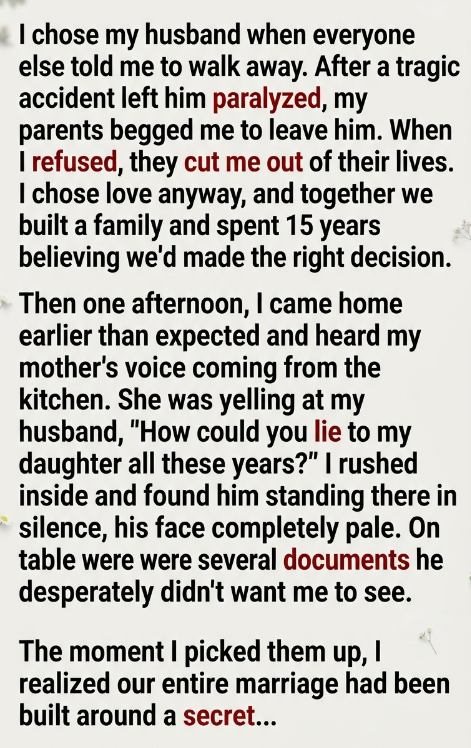
Three months before our wedding, my fiancé, Daniel, was involved in a terrible car accident.
He survived.
But the injury left him paralyzed from the waist down.
The hospital was filled with whispers.
“You still have time.”
“You’re too young.”
“Don’t throw your life away.”
The loudest voices belonged to my parents.
My mother cried.
My father begged me to reconsider.
“You’ll spend your life taking care of him.”
“I love him,” I answered.
“Love isn’t enough.”
“It is for me.”
When I refused to leave Daniel, my parents made a choice of their own.
They cut me out of their lives.
No phone calls.
No birthdays.
No holidays.
Nothing.
It hurt more than I ever admitted.
But Daniel and I built a beautiful life anyway.
We had two children.
Started a small business together.
Learned that marriage wasn’t about who could walk—it was about who stayed.
For fifteen years, I never questioned that decision.
Then everything changed.
One Thursday afternoon, I came home earlier than usual after a meeting was canceled.
As I stepped inside, I heard my mother’s voice.
I froze.
I hadn’t heard it in over a decade.
She was standing in my kitchen.
Shouting.
“How could you lie to my daughter for fifteen years?”
Daniel stood silently beside the table.
His face was completely white.
Between them lay several documents.
The moment he saw me, he whispered,
“Please…”
“Don’t read those.”
My hands were already reaching for the papers.
The first page was a medical report.
The second contained letters from specialists.
Then I saw the words that made my knees weak.
Neurological Recovery Assessment
According to the report…
Daniel had regained partial movement in his legs nearly twelve years earlier.
I couldn’t breathe.
I looked at him.
“What is this?”
Tears filled his eyes.
“I can explain.”
I stepped backward.
“For twelve years…”
“…you could walk?”
He shook his head immediately.
“Not like you’re thinking.”
“But you hid it.”
“Yes.”
I looked at my mother.
“How did you even get these?”
She quietly answered,
“I work with a patient advocate now.”
“One of the doctors recognized Daniel’s name.”
“He thought you already knew.”
Silence filled the room.
I turned back to my husband.
“Tell me the truth.”
He slowly lowered himself into a chair.
“I regained limited movement after years of therapy.”
“I can stand for short periods.”
“I can take a few steps with braces.”
“But it’s painful.”
“And dangerous.”
I stared at him.
“So why hide it?”
He looked at our wedding photo hanging on the wall.
“Because I was terrified.”
“Of what?”
He closed his eyes.
“That if your parents found out…”
“…they’d say they were right.”
“They’d tell everyone you sacrificed your youth for nothing.”
“I couldn’t bear the thought of them believing your love had only been worthwhile because I improved.”
I frowned.
“That doesn’t make any sense.”
“It did to me.”
He continued quietly.
“I also feared something else.”
“What?”
“That once you saw me standing…”
“…you’d start expecting more.”
“That every day I’d disappoint you because I still couldn’t be the husband I wanted to be.”
I sat down across from him.
“You thought I’d love you less if you got better?”
“No.”
“I thought you’d be disappointed that I didn’t recover completely.”
Tears rolled down his face.
“I’d spent years measuring myself by everything I still couldn’t do.”
My anger slowly gave way to heartbreak.
Not because he’d hidden the truth.
Because he’d carried that fear alone for twelve years.
Then my mother spoke.
“I was angry because I thought he was deceiving you.”
She looked at Daniel.
“But now I think…”
“…you were mostly deceiving yourself.”
The room became quiet.
For the first time in fifteen years, the three of us simply talked.
Really talked.
Hours passed.
Old wounds surfaced.
Some healed.
Some didn’t.
Before my mother left, she looked at me.
“I was wrong.”
I blinked.
“What?”
“I thought your life would be ruined.”
She smiled sadly.
“But you’ve built something stronger than I ever understood.”
Then she looked at Daniel.
“And you…”
“Stop deciding what other people can handle.”
“Especially the woman who already proved she’d stay.”
The following month, Daniel invited me to his therapy session.
For the first time, I watched him stand.
Slowly.
Painfully.
Using braces and parallel bars.
He took six trembling steps.
Then looked at me, embarrassed.
“I’m sorry it isn’t more.”
I walked over and hugged him.
“I didn’t marry your legs.”
“I married your heart.”
Years later, people sometimes ask us the secret to a long marriage.
Daniel usually smiles and says,
“Honesty.”
Then he looks at me and laughs.
“I learned that one the hard way.”
Our marriage wasn’t built on the absence of secrets.
It survived because, eventually, we stopped carrying them alone.
Looking back, the greatest lie wasn’t that Daniel hid his recovery.
It was the fear that convinced him he had to.
Love doesn’t demand perfection.
It doesn’t even demand complete healing.
It simply asks one question, over and over again.
“Will you trust me enough to let me walk beside you—even on the days you can’t stand on your own?”
That’s the question we finally answered together.