Tax season has always been my responsibility.
Every spring, I gathered receipts, bank statements, and last year’s tax return from the same filing cabinet in our home office.
This year, something felt strange.
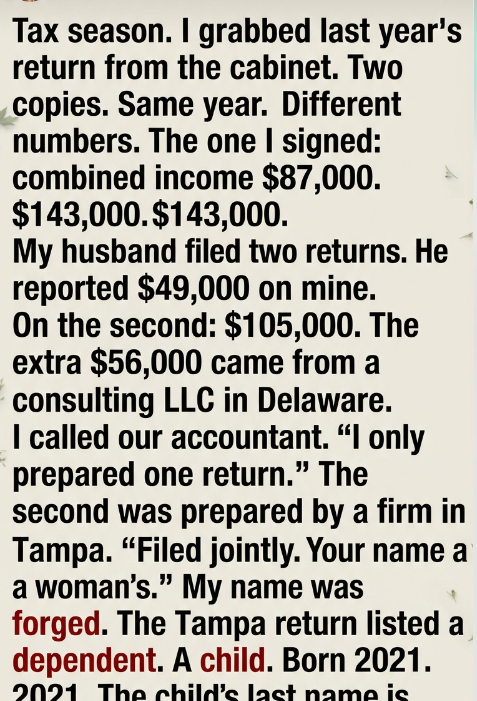
There were two tax returns for the same year.
At first, I assumed one was a draft.
Then I looked closer.
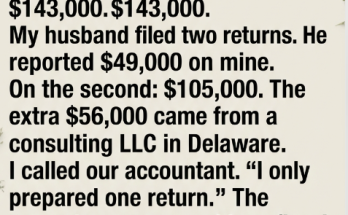
The return I remembered signing reported a combined household income of $87,000.
The second reported $143,000.
My hands started shaking.
According to the second return, my husband’s income wasn’t $49,000.
It was $105,000.
The extra income came from a consulting company registered in Delaware.
I had never heard of the company.
I called our accountant immediately.
“Did you prepare two returns?”
He sounded confused.
“Absolutely not.”
“I prepared only one.”
I emailed him the second document.
A few minutes later, he called back.
“That wasn’t created by my office.”
“It came from another tax preparation firm.”
“Which one?”
He gave me the name of a firm in Tampa.
I contacted them.
The woman on the phone searched their records.
Then she became unusually quiet.
“Ma’am…”
“According to our file, this return was filed jointly.”
“That’s impossible.”
“I filed jointly with my husband through our accountant.”
She hesitated.
“The return in our system includes your name…”
“…and another woman.”
My heart stopped.
“What?”
“The signature appears to be yours.”
“It isn’t.”
Then she said something even worse.
“The return also claims one dependent.”
“A child.”
I could barely breathe.
“What child?”
“Date of birth…”
She read the year.
The child carried my last name.
Not my husband’s.
Mine.
I felt sick.
The address listed on the return belonged to an apartment building in Tampa.
Then I recognized it.
Years earlier, my husband had told me his company rented temporary housing there whenever employees traveled for projects.
I hired an attorney before confronting him.
She immediately advised me not to accuse anyone until we had all the facts.
A forensic document examiner confirmed my signature on the Tampa return had been forged.
The attorney then requested records from the Delaware company.
The truth unfolded piece by piece.
The consulting company was real.
My husband had created it without telling me.
But the second tax return wasn’t filed by him.
It had been filed by someone using stolen personal information—including mine.
Investigators eventually discovered that a former business associate of my husband’s had created fraudulent filings while embezzling money through several shell companies.
To make the fake consulting income appear legitimate, he had fabricated tax documents using identities connected to people in the business.
My forged signature was one of many.
The woman listed on the return wasn’t my husband’s secret wife.
She was another victim whose identity had also been stolen.
The child’s name had been added fraudulently to claim tax credits.
Even the Tampa address belonged to a mailbox service that hundreds of businesses used—not an actual residence.
Federal investigators later linked the scheme to a much larger identity-theft operation.
Dozens of fraudulent tax returns had been submitted using forged signatures and fabricated family information.
The false filings had generated hundreds of thousands of dollars in fraudulent refunds before the operation was uncovered.
It took months to correct my tax records.
The process was exhausting.
But eventually, every fraudulent filing connected to my identity was removed.
One evening, after everything was finally resolved, my husband quietly said,
“When you found that second return…”
“You thought I’d been living another life.”
I nodded.
“I did.”
He smiled sadly.
“So did I.”
“What do you mean?”
“I spent months wondering why strangers kept calling about accounts I’d never opened.”
We both laughed—a little from relief, a little from sheer exhaustion.
The experience taught me something I never expected.
Sometimes the most frightening discovery isn’t proof that someone you love betrayed you.
Sometimes it’s proof that a stranger has quietly stolen pieces of your life without you even knowing.
Every year now, when tax season arrives, I still pull our records from the cabinet.
But before filing anything, I verify every document, every account, and every signature.
Not because I stopped trusting my husband.
Because I learned that protecting your identity is just as important as protecting your finances.
And sometimes, the most dangerous secrets aren’t hidden inside your marriage…
…they’re hidden inside paperwork that looks perfectly ordinary until you read it twice.