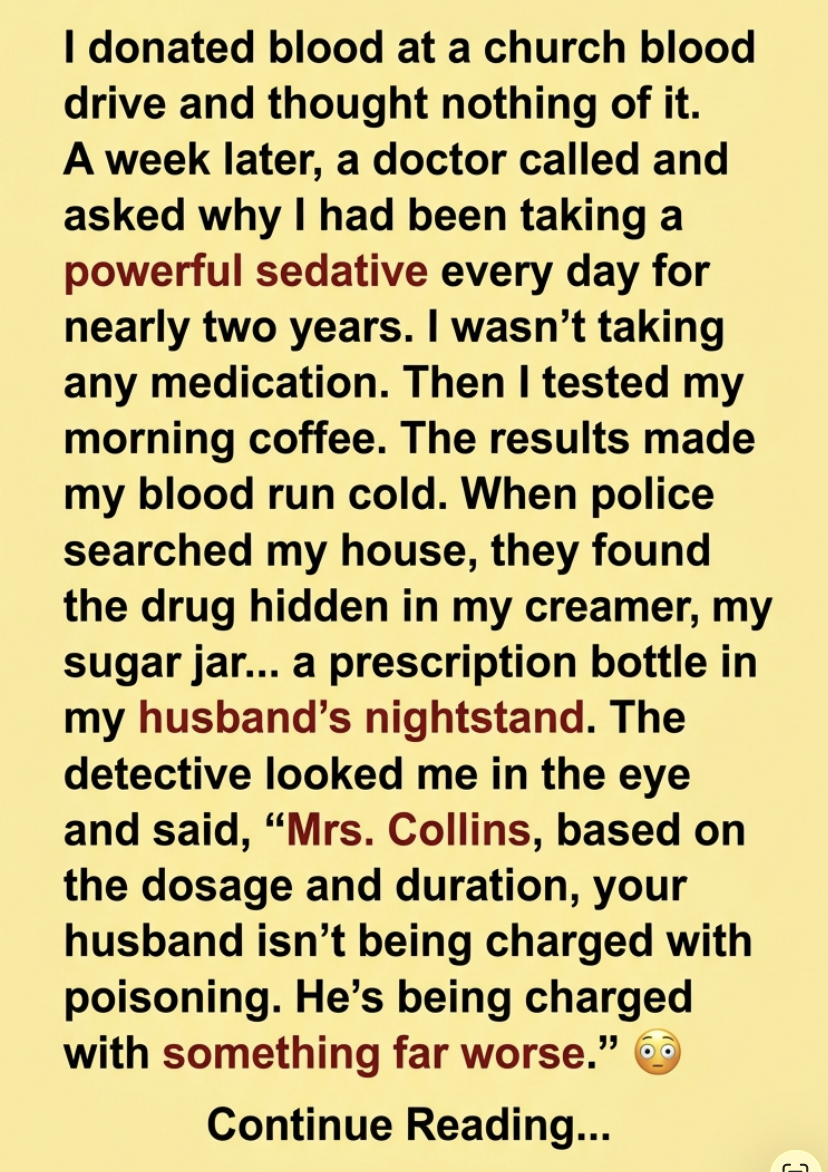
The call came on a Thursday afternoon.
I was folding laundry when my phone rang.
Unknown number.
Normally, I ignored those.
For some reason, I answered.
“Mrs. Collins?”
“Yes?”
The man introduced himself as a physician affiliated with the regional blood bank.
His voice sounded careful.
Almost rehearsed.
“Before we continue, I need to verify some information.”
After confirming my identity, he asked a question that made absolutely no sense.
“How long have you been taking alprazolam?”
I laughed.
“I’m not.”
The doctor didn’t laugh back.
There was a long silence.
Then he said:
“Your blood sample contains levels consistent with regular exposure over an extended period.”
The laundry basket slipped from my hands.
“What?”
“Mrs. Collins, based on the concentration, this doesn’t appear to be accidental exposure.”
I sat down.
Hard.
For almost two years I’d felt different.
Exhausted.
Forgetful.
Foggy.
I’d walk into rooms and forget why.
Lose conversations halfway through.
Misplace keys.
Miss appointments.
My husband, Greg, always blamed stress.
Getting older.
Hormones.
Life.
Eventually, I believed him.
After all, what other explanation was there?
The next morning, I called my doctor.
Then a toxicologist.
Then a private laboratory.
I wanted answers.
Within forty-eight hours, I had them.
And I wished I didn’t.
The toxicologist asked about my daily routine.
Every detail.
Coffee.
Breakfast.
Medications.
Supplements.
Then she suggested testing anything I consumed regularly.
I started with my coffee.
Positive.
I thought the lab had made a mistake.
So I tested the creamer.
Positive.
Then the sugar jar.
Positive.
My hands started shaking.
I stared at the results spread across my kitchen table.
The drug wasn’t accidentally contaminating my food.
Someone was putting it there.
Deliberately.
Systematically.
For years.
There was only one other person who regularly prepared my morning coffee.
My husband.
Twenty-four years married.
The father of my children.
The man who kissed me goodbye every morning.
The man I trusted with my life.
I called the police.
The detective who arrived was named Alvarez.
At first, I could tell he was skeptical.
Then he saw the laboratory reports.
His entire attitude changed.
Two days later, investigators executed a search warrant.
I sat in my living room while officers searched the house.
The longest three hours of my life.
Then Detective Alvarez emerged from our bedroom carrying a clear evidence bag.
Inside was a prescription bottle.
Not in my name.
Not even in Greg’s.
The pills matched the drug found in my blood.
My stomach dropped.
I thought that was the worst part.
It wasn’t.
Not even close.
The detective sat across from me.
Folded his hands.
And said something I’ll never forget.
“Mrs. Collins, your husband isn’t being investigated for poisoning.”
I stared at him.
“What do you mean?”
His expression hardened.
“Based on the dosage and duration, we believe he was trying to impair your judgment and decision-making over time.”
I felt sick.
The detective continued.
“This appears to be a long-term coercive control case.”
The room spun.
Over the next week, investigators uncovered things I couldn’t explain.
Documents I didn’t remember signing.
Bank account changes.
Insurance modifications.
Beneficiary updates.
Retirement paperwork.
Power-of-attorney forms.
Every document carried my signature.
At least it looked like my signature.
But I couldn’t remember signing any of them.
Then forensic specialists reviewed the dates.
Most were executed during periods when toxicology experts believed I was heavily sedated.
I started crying.
Because suddenly dozens of strange memories made sense.
The times Greg insisted I was confused.
The times he corrected my recollection of events.
The times he told friends I was becoming forgetful.
The times he joked that I was “losing my mind.”
He wasn’t observing a decline.
He was creating one.
Then investigators searched his office.
What they found changed the entire case.
A notebook.
Small.
Black.
Ordinary.
Inside were handwritten entries spanning nearly two years.
Dose amounts.
Dates.
Observations.
Adjustments.
Like a science experiment.
One entry read:
“Still questioning finances. Increase slightly.”
Another:
“More agreeable this month.”
I couldn’t breathe.
The man I married had been documenting my deterioration.
As if it were a project.
Then came the motive.
Money.
Of course it was money.
Investigators discovered that Greg had accumulated enormous gambling debts.
Hundreds of thousands of dollars.
Far more than I ever knew.
He’d taken out secret loans.
Maxed out credit lines.
Lost money in online betting accounts.
When the debts became impossible to hide, he needed access to our assets.
And he needed me too impaired to stop him.
The prosecutor later described it perfectly.
“He wasn’t trying to kill her. He was trying to erase her.”
That sentence haunted me.
Because it was true.
Death would have been simpler.
Instead, he wanted me alive.
Dependent.
Confused.
Easily manipulated.
A legal obstacle slowly transformed into a person nobody would question.
Then investigators uncovered something even darker.
Emails.
Dozens of them.
Messages to friends and relatives.
Greg repeatedly suggested I might be developing dementia.
He planted seeds everywhere.
Quietly.
Patiently.
If anyone questioned future financial decisions, he already had an explanation.
Poor Karen.
She’s not herself anymore.
It was all planned.
Every bit of it.
The arrest happened six months later.
He looked shocked.
Not guilty.
Not remorseful.
Just shocked he’d been caught.
The trial lasted three weeks.
Experts testified about toxicology.
Neurology.
Financial exploitation.
Coercive control.
The jury saw the notebook.
The bank records.
The laboratory reports.
The emails.
Everything.
Then I testified.
I expected anger.
Instead, I felt sadness.
The deepest sadness I’d ever known.
Because sitting at that defense table wasn’t a monster from a movie.
It was my husband.
The man who taught our daughter to ride a bike.
The man who held my hand when my mother died.
The man who somehow became a stranger.
When the verdict came back guilty, Greg never looked at me.
Not once.
The judge sentenced him to years in prison.
Then he said something I’ll never forget.
“Trust is one of the most valuable things a person can give another. The defendant weaponized that trust for personal gain.”
Afterward, reporters waited outside.
Microphones.
Cameras.
Questions.
One reporter asked:
“Do you hate him?”
I thought about it.
Long and hard.
Then answered honestly.
“No.”
The reporter looked surprised.
I continued.
“Hate means carrying him with me.”
What I felt wasn’t hate.
It was grief.
For the marriage I thought existed.
For the memories that now felt poisoned.
For the years I’ll never fully get back.
Recovery wasn’t quick.
The drugs left my system within weeks.
The emotional damage took much longer.
Months later, the fog finally began lifting.
My energy returned.
My memory improved.
My confidence slowly came back.
One morning I made coffee.
Just coffee.
No testing kits.
No fear.
No suspicion.
I sat by the kitchen window and took a sip.
Then another.
And suddenly I started crying.
Because it tasted like freedom.
The simplest thing in the world.
A cup of coffee.
Yet for the first time in years, it belonged entirely to me.
And in that moment, I realized something important.
The worst thing Greg tried to steal wasn’t my money.
It wasn’t my property.
It wasn’t even my future.
It was my ability to trust my own mind.
And getting that back was the greatest victory of all.
The End. ❤️☕💔