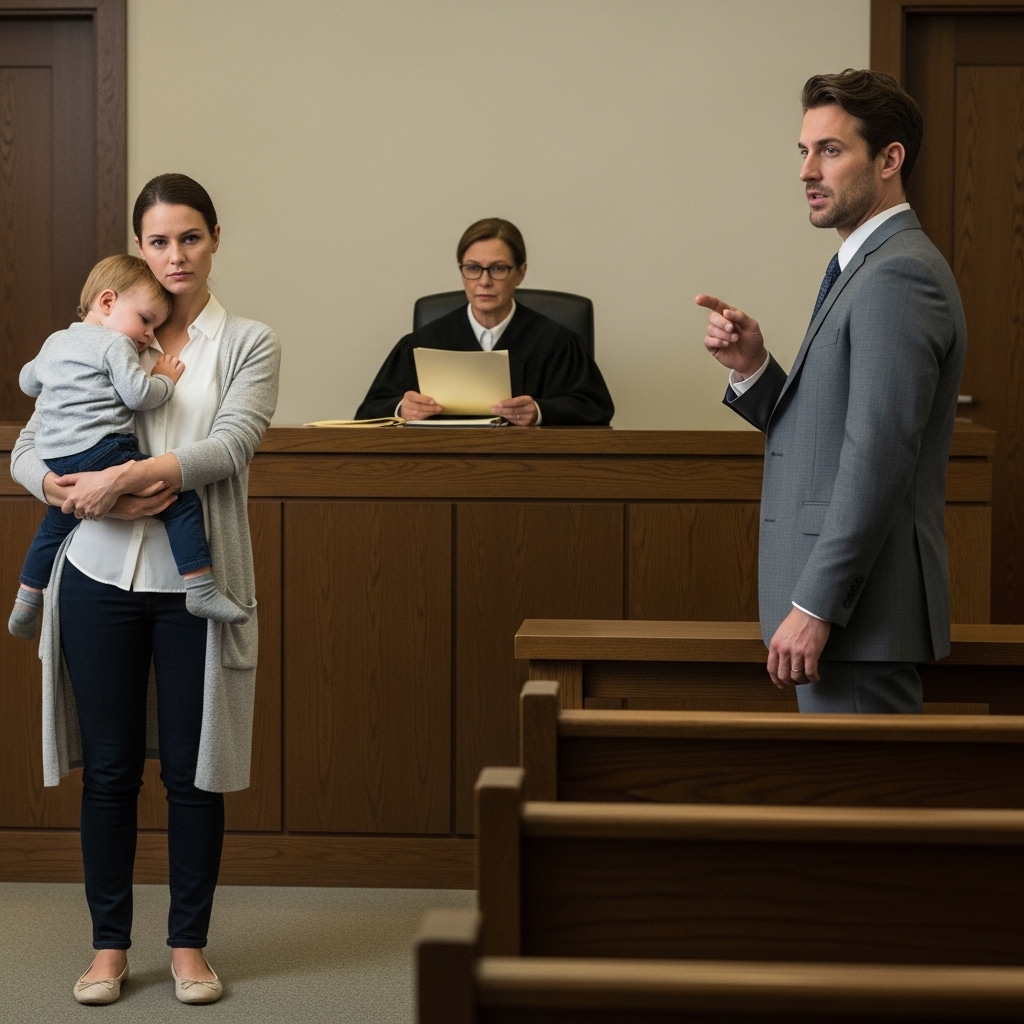
The courtroom felt colder than it should have. Not just the air—the silence, the stares, the way every sound echoed made it worse.
My son was crying on my shoulder. He was barely two, confused by the strange room, the raised voices, the tension he couldn’t understand. I rocked him gently, whispering to him, trying to keep him calm while my own hands shook.
Then my husband, Marcus, pointed straight at us.
“Take your kid and get out,” he said.
Not quietly. Not privately.
Loud enough for the judge, the lawyers, and everyone sitting behind us to hear.
A few people shifted uncomfortably. Someone behind me sucked in a breath. Marcus didn’t care. His lawyer leaned back in his chair and smirked, as if this was already over.
They had offered me a deal earlier that morning. A small settlement. Just enough money to make me go away quietly. No fight. No custody battle. No questions.
They honestly thought I’d take it.
Standing there, holding my son, I suddenly felt invisible. Reduced to an inconvenience they wanted removed.
For years, I had been the stable one. I worked two jobs—one during the day, one at night—while Marcus chased what he called his “big break.” Acting gigs that never paid. Business ideas that never lasted. Promises that tomorrow would be different.
I paid the rent.
I paid the utilities.
I bought the diapers, the formula, the groceries.
I cooked the meals and put our son to bed while Marcus stayed out “networking.”
And yet, in that courtroom, I was treated like I was nothing.
So I didn’t argue.
I didn’t cry.
I didn’t defend myself.
I just held my son tighter and stayed quiet.
I let them think they were winning.
That’s when the judge stopped flipping through the paperwork.
She frowned slightly, leaned forward, and reread a single page. The room went completely silent. Even my son’s crying slowed, like he sensed something had shifted.
She looked up—first at me, then at Marcus.
“Mr. Hale,” she said calmly, “were you aware that your wife is the sole owner of the downtown commercial property on Main Street?”
Marcus blinked.
“What?” he said, a nervous laugh slipping out. “That—that must be a mistake.”
The judge didn’t smile.
“It’s not,” she said. “The deed was transferred to her name six years ago. Purchased before your marriage, refinanced solely under her income, and never commingled.”
His lawyer stiffened.
I finally spoke, my voice quiet but steady.
“My grandmother left me the money,” I said. “Marcus knew about the property. He just never asked whose name it was in.”
The color drained from Marcus’s face.
That building—three storefronts downtown—had been quietly paying our bills for years. I never talked about it. Not because I was hiding it, but because Marcus never cared where the money came from as long as it showed up.
The judge closed the file.
“Given this information,” she said, “the proposed settlement is inappropriate.”
The smirk disappeared from Marcus’s lawyer’s face.
By the end of the hearing, the outcome was clear. I retained full ownership of my property. Primary custody of our son was granted to me. Marcus was ordered to pay child support—something he had laughed at the idea of earlier that day.
When it was over, Marcus didn’t look at me. He walked out of the courtroom without saying a word.
I sat there for a moment longer, my son finally asleep on my shoulder, his tiny hand gripping my collar.
I didn’t feel victorious.
I felt tired.
But also… lighter.
Real life doesn’t always come with dramatic speeches or instant revenge. Sometimes it’s quieter than that. Sometimes justice looks like a judge reading one line carefully—and finally seeing the truth.
I left the courthouse that day not with triumph, but with something better.
Security.
Peace.
And the knowledge that I had protected my child without ever having to raise my voice.