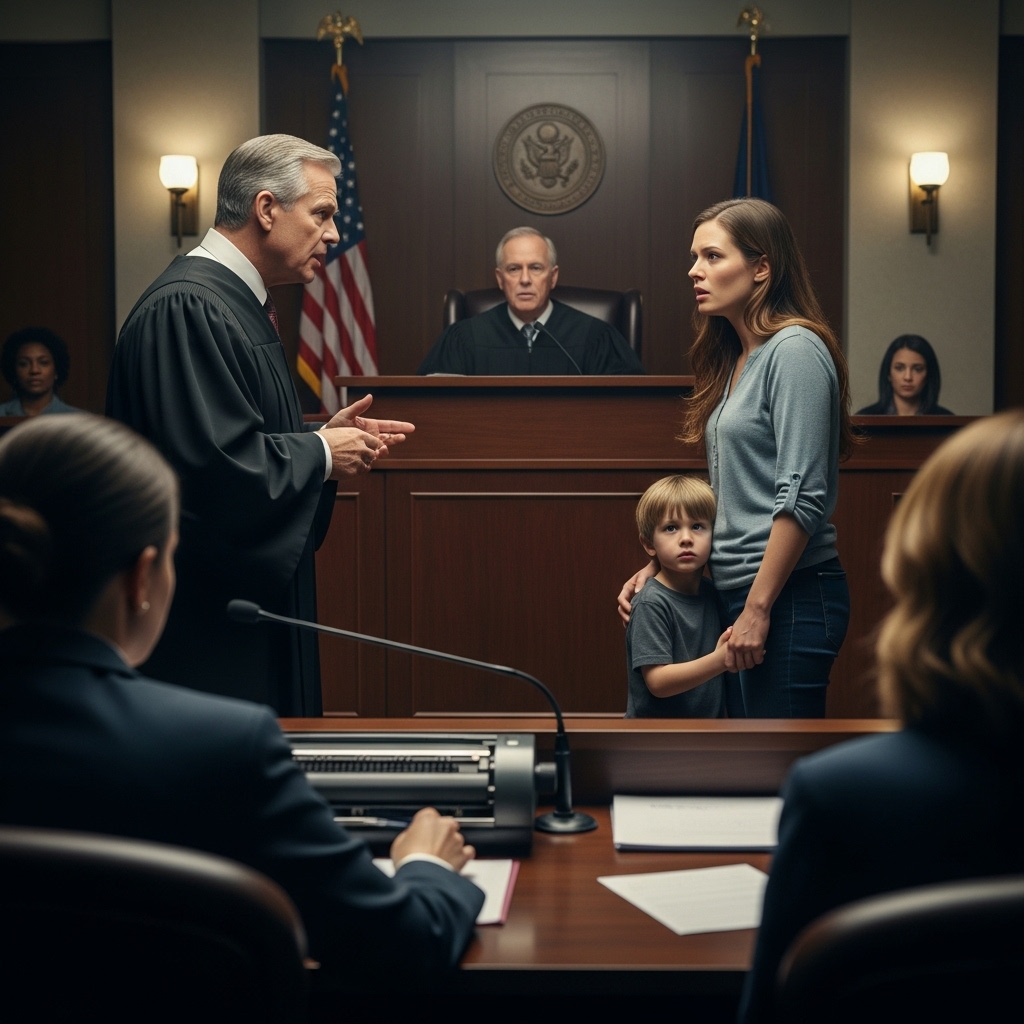
The courtroom was cold in a way that went deeper than temperature. It crept into my bones and settled there. My little boy was crying softly on my shoulder, his small fingers clutching my jacket, confused and tired. I rocked him gently, whispering that it would be okay, even though I wasn’t sure I believed it myself.
Across the room, my husband Marcus stood tall and confident, flanked by his lawyer. He didn’t look at our son. He didn’t hesitate. He lifted his arm and pointed directly at us.
“Take your kid and get out,” he said, loud enough for everyone to hear.
A ripple of murmurs moved through the courtroom. My heart slammed against my ribs, but I didn’t move. Marcus’s lawyer smirked, already flipping through papers like this was a formality. They had offered me a deal earlier—barely enough money to cover a few months’ rent if I agreed to disappear quietly and give Marcus full custody. Pocket change in exchange for my silence, my dignity, and my child.
They thought I was desperate.
For years, I had been the one holding everything together. I worked two jobs while Marcus chased his “big break,” hopping from idea to idea, always convinced success was just around the corner. I paid the bills. I bought the diapers. I cooked the meals. I stayed up through fevers and sleepless nights. Marcus liked to call himself the visionary. I was the one keeping the lights on.
But in that courtroom, none of it seemed to matter.
I stood there silently, holding my son closer, his cries muffled against my shoulder. I didn’t argue. I didn’t defend myself. I didn’t explain. I let Marcus and his lawyer believe they were winning. Sometimes the smartest thing you can do is wait.
That’s when everything shifted.
The judge, a woman with calm eyes and a steady presence, stopped flipping through the stack of documents in front of her. She frowned slightly and leaned forward, pulling one page out and reading it again—slowly, carefully.
The room went quiet. Even my son seemed to sense the change, his crying fading into soft hiccups.
The judge looked up from the paper, first at me, then at Marcus. Her voice, when she spoke, was measured and calm.
“Mr. Hale,” she said, “were you aware that your wife is the sole owner of the downtown commercial property on Main Street?”
Marcus’s face drained of color.
His lawyer froze mid-motion.
The silence was heavy.
Marcus stammered, “That—that can’t be right.”
The judge lifted the document slightly. “The deed is very clear. The property was purchased prior to your marriage, remains solely in her name, and generates consistent rental income.”
For the first time, Marcus looked at me—not with anger or superiority, but with fear.
What he didn’t know was that years ago, before we married, my grandmother had left me that property. I never talked about it. I used the income quietly, responsibly—paying bills, supporting our household, making sure our son never went without. Marcus assumed everything we had came from his potential, his future success.
The judge continued, “This income, combined with documented proof of primary caregiving and financial responsibility, significantly impacts custody and support considerations.”
Marcus’s lawyer tried to recover, mumbling something about reassessing their position.
The judge raised a hand. “I think we’re done with assumptions today.”
She looked at me again, her expression softening. “You may step forward with your son.”
I did.
For the first time since entering that courtroom, I felt steady.
By the end of the hearing, the deal Marcus had been so confident about was gone. Custody arrangements were revised. Support was recalculated. And the narrative he had tried to sell—that I was nothing without him—collapsed under the weight of the truth.
As I walked out of the courtroom, my son asleep against my shoulder, Marcus remained seated, staring at the table in front of him.
He had told me to take my son and leave.
In the end, I did.
But I left with my dignity intact, my child beside me, and the quiet satisfaction of knowing that sometimes, the most powerful moment isn’t when you speak—it’s when the truth finally speaks for you.