My dad died in 2026.
There was no dramatic goodbye. No final speech. Just a phone call that changed everything in a single sentence.
By the time I reached the hospital, he was already gone. The room was quiet in a way that felt wrong—like the world had decided to keep moving without asking me first.
I was still numb when the funeral happened. People hugged me, told me I was “so strong,” said things like he’s in a better place now. I nodded because that’s what you’re supposed to do when you’re too broken to argue.
My mother cried loudly that day.
Louder than anyone else.
At the time, I believed her grief was real.
I was wrong.
Less than a year later, she betrayed him for a truly bad man.
Not someone gentle. Not someone kind.
But a man who took up space like he owned it.
A man who smiled with his mouth and judged with his eyes.
She didn’t ease him into our lives.
She forced him in.
Suddenly, he was always there—sitting in my dad’s chair, eating at the table where my dad used to pray, touching things that still felt sacred to me. My mother acted like this was normal. Like love was something you could swap out without consequence.
I watched our family collapse quietly.
Relatives stopped visiting.
Friends stopped asking questions.
And my home stopped feeling like one.
She destroyed our family, piece by piece, and called it “moving on.”
That man tried to be my father.
He told me how to dress.
How to speak.
How to show respect.
Once, he corrected me when I mentioned my dad.
“He wouldn’t have wanted it that way,” he said.
I stared at him and felt something inside me go cold.
I refused him—not with shouting, not with rebellion—but with distance.
I answered politely.
I never asked for advice.
I never shared my life.
He noticed.
My mother noticed too.
“You’re being unfair,” she told me more than once.
“He’s trying.”
But trying to replace someone who raised me, loved me, and shaped me wasn’t effort.
It was disrespect.
Years passed.
I moved out.
Built my own routine.
Created a life that didn’t include either of them much.
When I got engaged, I didn’t tell my mother right away.
Part of me already knew what would come next.
I was right.
The moment wedding plans started, she made her demand.
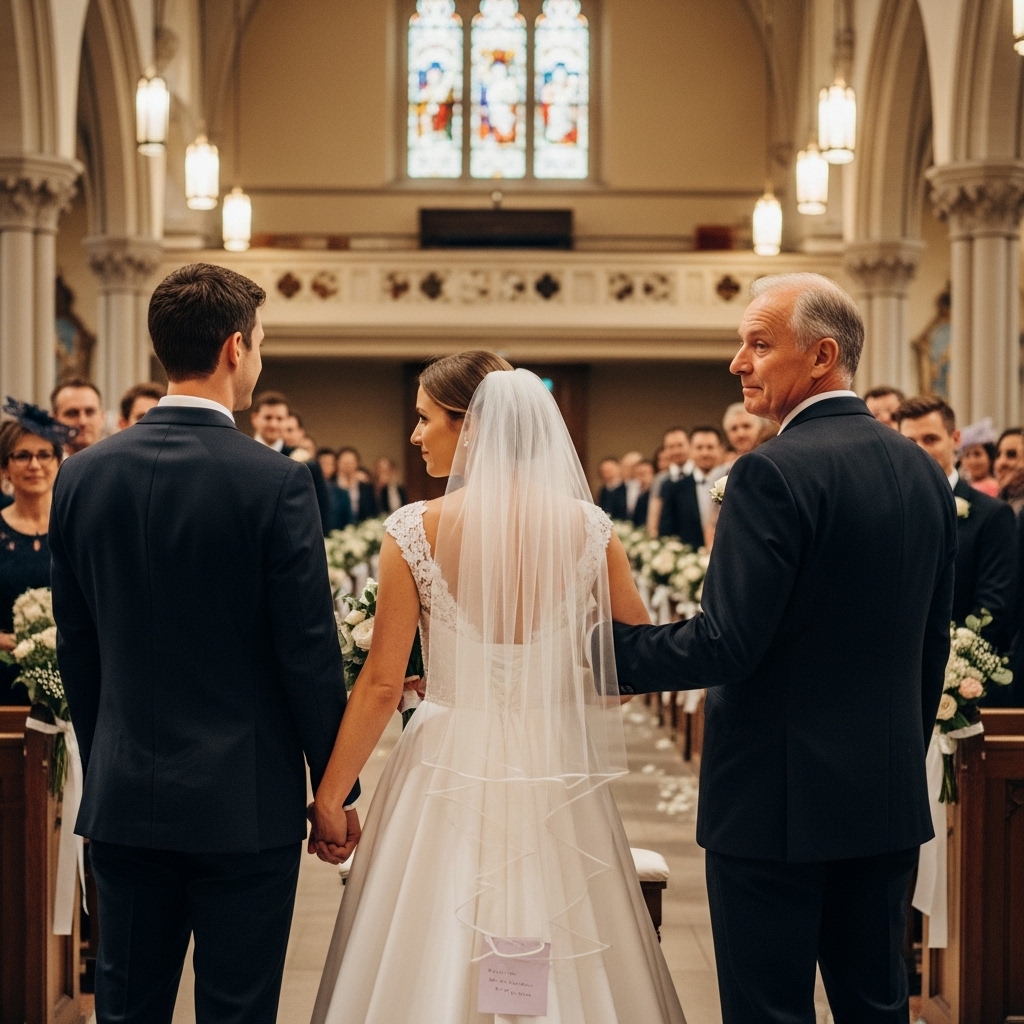
She wanted him to walk me down the aisle.
She said it would look “wrong” if I walked alone.
She said people would talk.
She said it would mean the world to her.
I said no.
She cried.
She begged.
She accused me of holding grudges.
Then she used the one thing she knew would hurt.
“You don’t have a father anymore,” she said.
Something inside me cracked that day.
After weeks of fighting, guilt, and exhaustion, I finally agreed.
But not because she convinced me.
Because I had already decided on something else.
On my wedding day, I was calm in a way that surprised even me.
My dress was perfect. My hands steady.
When the music began and the doors opened, I could feel the expectation in the room. People leaned forward, ready to see us walk together.
But he wasn’t beside me.
I stepped forward alone.
Gasps rippled softly through the guests.
I heard my mother inhale sharply.
Halfway down the aisle, I stopped.
I reached into my bouquet and pulled out a small framed photo—my dad and me, laughing on an ordinary afternoon that suddenly felt priceless.
I held it close to my heart and kept walking.
No explanation.
No speech.
Just truth.
At the altar, I placed the photo gently beside me.
My mother couldn’t look at me.
And for the first time in my life, I didn’t care.
Because my father was there.
In every step I took.
In every boundary I finally held.
In every choice I made for myself.
I didn’t erase him to make someone else comfortable.
I honored him.
And I walked into my future exactly the way I was meant to—
without replacements, without lies, and without regret.