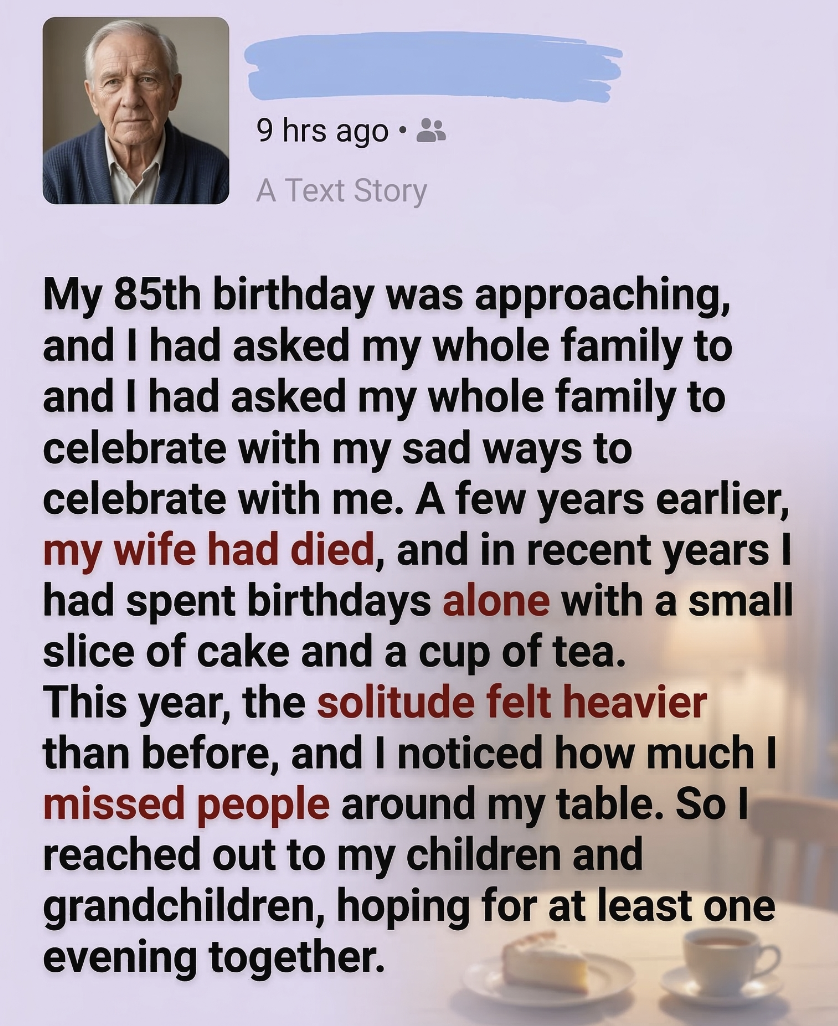
My 85th birthday was approaching, and I had asked my whole family to celebrate with me.
A few years earlier, my wife had died, and in recent years I had spent birthdays alone with a small slice of cake and a cup of tea. This year, the solitude felt heavier than before, and I noticed how much I missed people around my table. So I reached out to my children and grandchildren, hoping for at least one evening together.
For three days, I cleaned the house and polished the old dishes my wife and I had once used for family gatherings. I baked my children’s favorite pies, laid out a large table, and put fresh flowers in the center. I longed for the familiar clatter, laughter, and warmth — the sounds that used to fill these rooms.
On the morning of my birthday, I woke earlier than usual.
The house felt different — expectant, almost alive. I put on the suit my wife used to like, the one she said made me look “like a gentleman even when I wasn’t behaving like one.” I smiled at the memory.
By noon, everything was ready.
I checked my phone. No messages yet, but that was alright. People were busy. Families had their own rhythms. I understood that. I sat down for a moment, then stood again, unable to stay still. I adjusted the plates. Moved the flowers slightly to the left. Straightened the napkins for the third time.
At one o’clock, I heard a car outside.
My heart lifted.
But it passed by.
I told myself not to be foolish. It was still early.
By three, the pies had cooled, and the sunlight shifted across the table, casting long shadows where faces should have been. I made myself a cup of tea, though I didn’t drink it. I kept listening — for footsteps, for laughter, for a knock on the door.
Nothing came.
At four, I checked my phone again. A message this time.
“Sorry, Dad. Something came up. We’ll visit soon.”
Soon.
Such a small word. Such a distant promise.
Another message followed. And another.
Excuses, polite and hurried. Each one closing a door I had opened with such care.
By evening, the house was quiet again.
Too quiet.
I sat at the head of the table, surrounded by empty chairs. The flowers looked too bright, almost out of place. The plates gleamed as if waiting for a celebration that had forgotten its way.
For a long time, I didn’t move.
Then, slowly, I reached for one of the pies. I cut a small slice, just as I had done in the years before. I placed it on a plate and poured myself a cup of tea.
It felt like going backward in time — but not to the good parts.
I lifted the fork, but my hand trembled.
Not from age.
From something heavier.
I looked at the empty chair beside me — her chair.
“You would’ve scolded them,” I whispered.
And then, for the first time in years, I laughed softly.
Because it was true.
She would have called each one of them. She would have insisted. She would have made it impossible for them to forget.
She had always been the bridge.
And without her, we had all drifted.
The realization settled over me, not as bitterness, but as clarity.
This wasn’t just their absence.
It was mine too.
When she died, I had quietly stepped back from the world. I stopped calling as often. Stopped visiting. Stopped being the one who gathered everyone together. I had let grief turn me into someone who waited instead of someone who reached.
Tonight, I had reached.
But perhaps… too late, or too softly.
I looked around the table again — at the food, the chairs, the silence.
Then I did something I hadn’t done in a very long time.
I stood up with purpose.
I went to the phone.
My fingers hesitated for only a moment before dialing.
The first call went unanswered.
The second too.
But the third…
“Dad?”
It was my granddaughter.
“Happy birthday,” she said, her voice surprised, a little guilty.
“Thank you,” I replied. “Tell me… are you busy right now?”
A pause.
“…Not really.”
“I have a table set for ten,” I said. “And far too much pie for one old man. Would you come and help me fix that mistake?”
Another pause — shorter this time.
“I’ll be there,” she said.
When I hung up, the house felt different again.
Not full.
But no longer empty.
An hour later, there was a knock at the door.
Just one person.
But it was enough to start.
We sat together at the long table, two plates instead of ten. She laughed at how much food I had made, and I laughed with her. We talked — really talked — in a way we hadn’t in years.
Before she left, she hugged me tightly.
“I’ll bring everyone next time,” she said.
I didn’t answer right away.
I simply nodded.
Because I had learned something that day.
Families don’t gather on their own.
They are gathered.
And sometimes, even at 85, it isn’t too late to begin again.
That night, I cleared the table — not with sadness, but with a quiet kind of hope.
The table had waited.
And now, so would I.
But not silently anymore.