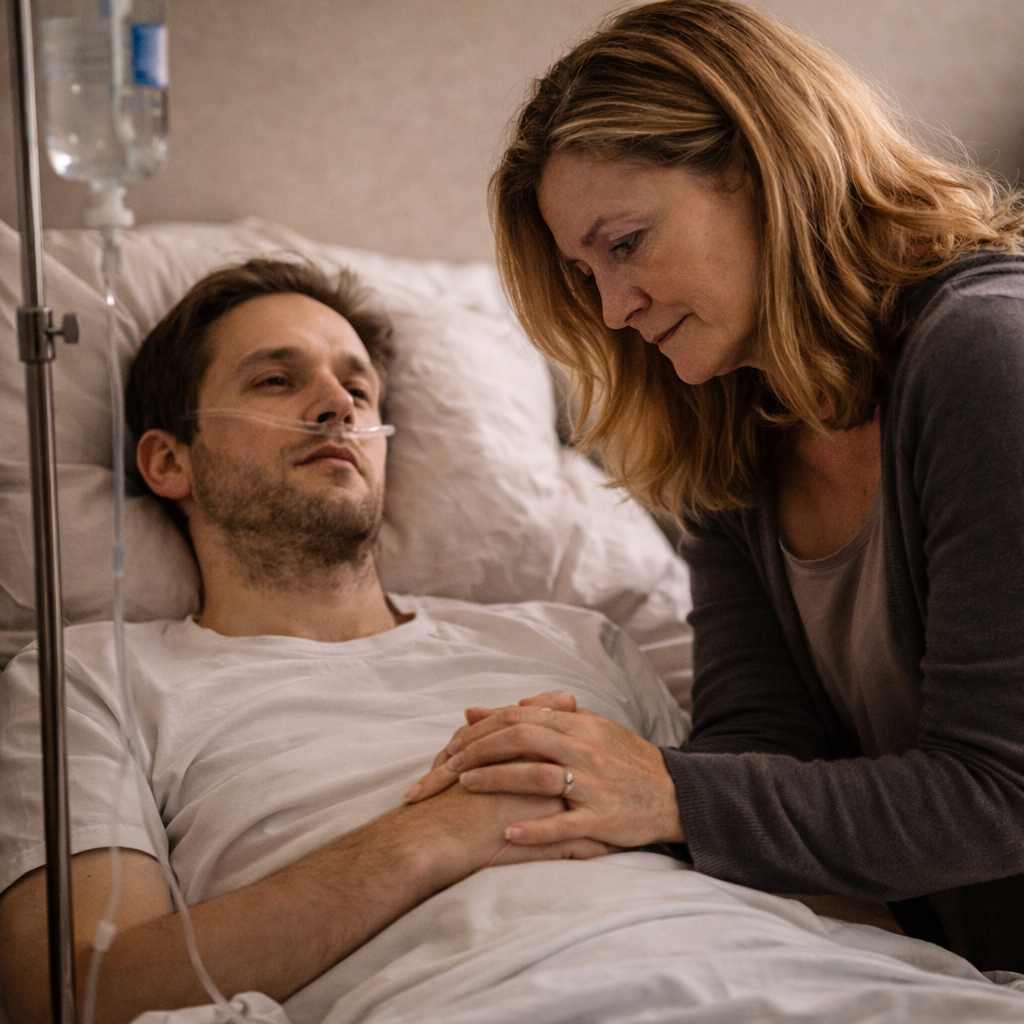
My son Matthew was only thirty-three when the headaches started.
At first, he blamed stress.
He worked long hours as a project manager for a construction firm and had recently bought his first home with his wife, Claire. Life seemed to be moving exactly the way it was supposed to.
A steady career.
A new house.
Plans for children.
Whenever I asked if he was feeling okay, he laughed it off.
“Just tired, Mom. I’ll sleep it off.”
Then one afternoon, he collapsed in his kitchen.
The phone call came from Claire.
Her voice sounded strange — calm, almost detached.
“They’re taking him to the hospital,” she said.
That was the beginning of everything.
Two weeks later, the neurologist called us into a quiet office.
Matthew had a rare neurological disease. Progressive. Aggressive. The kind doctors describe with careful words like degenerative and limited time.
I remember holding Matthew’s hand while the doctor explained how the illness would likely progress.
Loss of strength.
Loss of mobility.
Eventually, loss of speech.
I looked over at Claire.
She didn’t cry.
She didn’t even reach for Matthew.
Instead, she asked the doctor one question.
“How long?”
When the doctor explained the disease could take years — but those years would likely involve significant decline — Claire went silent.
That night, when we returned to Matthew’s house, she stood in the living room staring at him sitting weakly on the couch.
Then she said something I will never forget.
“I won’t waste my life watching you turn into a vegetable.”
The room went completely still.
She didn’t say it with anger.
She said it like someone stating a simple fact.
Matthew closed his eyes for a moment.
Then he said quietly, “It’s okay.”
Two days later, she packed her bags.
Matthew never begged her to stay.
He just looked at me and said, “She didn’t sign up for this, Mom.”
But I had.
Within a month, I sold my house.
Every piece of jewelry my late husband had ever given me. My car. My savings.
I moved into Matthew’s home so I could care for him full time.
At first, the disease moved slowly.
There were tremors in his hands.
Occasional weakness in his legs.
But then it accelerated.
Soon he couldn’t walk without help.
Then he couldn’t stand at all.
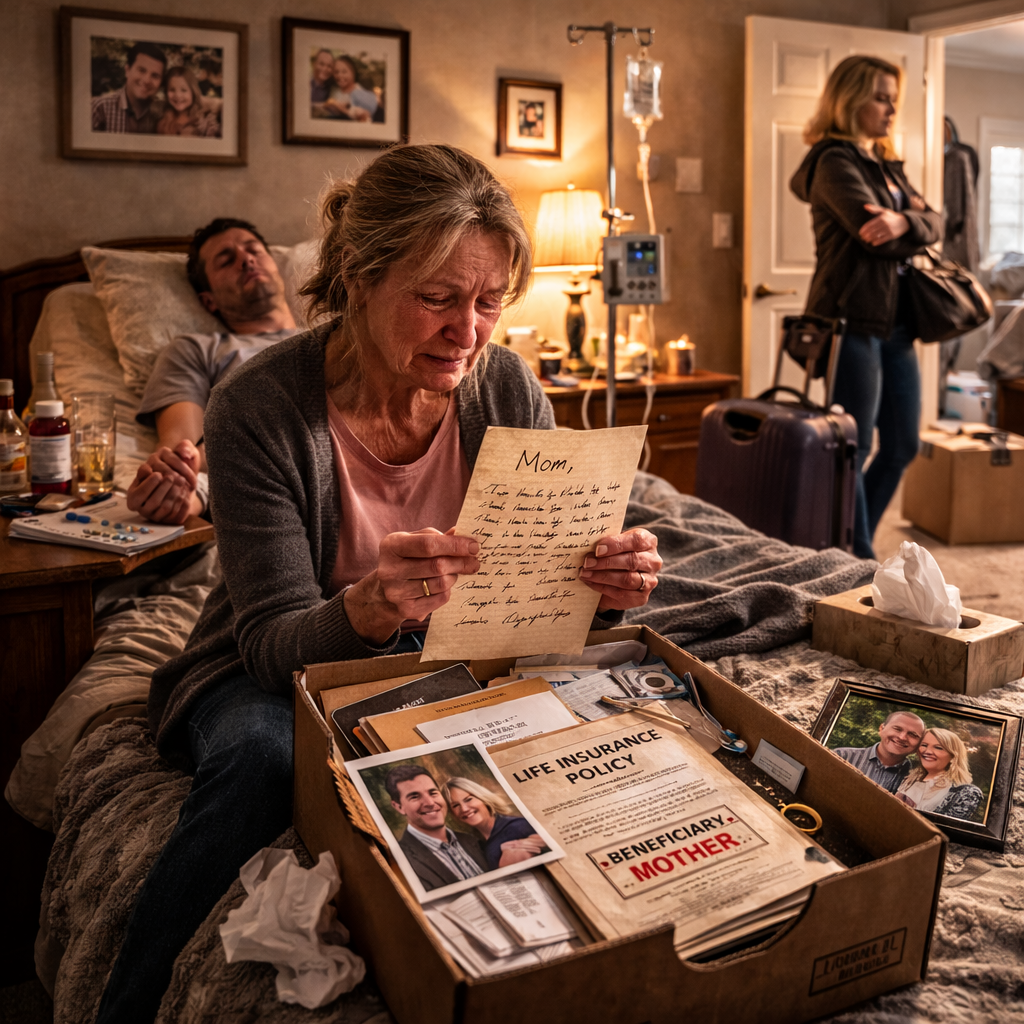
I learned things I never imagined I would need to know — how to administer medications, how to prevent bed sores, how to lift him safely from bed to wheelchair.
I cooked soft meals he could swallow.
I bathed him.
When pain kept him awake at night, I sat beside him in the dark telling stories from when he was little.
Sometimes I cried quietly in the bathroom so he wouldn’t hear.
But in front of him, I stayed strong.
Because that’s what mothers do.
Three years passed like that.
Three long, exhausting, beautiful years.
Then one winter morning, Matthew’s breathing became shallow.
The hospital room was quiet except for the steady hum of machines.
A nurse stood quietly near the doorway.
Matthew squeezed my hand once.
Just once.
Then he was gone.
The funeral was small.
Claire came.
She stood near the back in black, composed and distant.
Some people whispered about her.
Others avoided looking at her entirely.
Legally, she was still his wife.
Matthew had been too sick in the final months to update his will.
Which meant everything — the house, the accounts, the remaining assets — went to her.
Three days later, she sat across from me at the kitchen table.
“I’m selling the house,” she said flatly.
My chest tightened.
“And I can’t afford to keep you here.”
Just like that.
After three years of caring for him, I was no longer part of the picture.
I didn’t argue.
I didn’t have the strength left to fight.
I packed quietly.
Clothes. Photographs. A few things that held memories.
When I went into Matthew’s bedroom for the last time, I knelt down to check under the bed for anything I might have missed.
That’s when I saw it.
A shoebox.
Taped shut.
It looked ordinary.
For a moment I considered leaving it there.
But something told me to open it.
Inside were neatly organized folders.
Insurance documents.
Policies I had never seen before.
Each one recently updated.
And every single one listed the same beneficiary.
Me.
My hands began shaking as I opened the envelope on top.
Inside was a handwritten letter.
Mom,
If you’re reading this, it means you found the box.
I didn’t tell you about it because I knew you’d try to talk me out of it.
You already gave up your house, your savings, and three years of your life for me.
Claire and I were having problems long before I got sick. I knew there was a chance she wouldn’t stay.
But you did.
You stayed every night.
You never once made me feel like I was a burden.
I needed to make sure you were taken care of.
Please use this to rebuild your life.
And please don’t feel guilty.
Loving me was never something you owed me.
It was a gift.
I love you, Mom.
— Matthew
I sat on the floor and cried harder than I had since the day he died.
Not because of the money.
But because he had seen everything.
The exhaustion.
The sacrifices.
The nights I thought he didn’t notice.
The insurance payout was enough to replace everything I had sold — and more.
Weeks later, Claire called me.
“I didn’t know he had those policies,” she said quietly.
“He never told me.”
“He didn’t tell me either,” I replied.
“He just made sure.”
Months later, I bought a small home near the park Matthew loved when he was a boy.
And every year, on his birthday, I donate part of the money to families caring for loved ones with terminal illness.
Because I know what that kind of love costs.
Not just in money.
In time.
In sleep.
In pieces of your heart.
The shoebox Matthew left under his bed wasn’t really about insurance.
It was his way of saying something he didn’t always say out loud.
I saw everything you did for me.
And for a parent, that is worth more than anything else in the world.