When my mom told me not to visit for three months because of “renovations,” I didn’t question it.
She had always been private. Independent. The kind of woman who insisted on handling her own problems, even when she clearly needed help.
“It’s just a mess here,” she said on the phone. “Dust everywhere. Workers coming in and out. I don’t want you breathing that in.”
At first, I believed her.
But then her calls changed.
They became shorter. Colder. Mechanical.
She stopped asking about my job. Stopped telling me about her book club or the neighbors. When I suggested video calls, she always had an excuse.
“The Wi-Fi’s acting up.”
“Too tired tonight.”
“Another time.”
Something in her voice didn’t feel right. It wasn’t just distance.
It was strain.
After two and a half months, I couldn’t ignore the feeling anymore.
So I didn’t tell her I was coming.
I drove the three hours to her house on a Saturday morning.
From the outside, everything looked normal.
The paint wasn’t new. No scaffolding. No construction vans.
But the garden stopped me.
My mother loved her garden. Roses trimmed with precision. Hedges shaped cleanly. The lawn edged perfectly.
Now it was wild.
Weeds curling over the walkway. Bushes overgrown. Leaves piling in corners.
That was never like her.
I rang the doorbell.
No answer.
I used the spare key she had given me years ago.
Inside, the air felt heavy.
There were no renovations.
No dust. No plastic sheets. No tools.
The furniture was still in place.
But something was missing.
Sound.
The house was too quiet.
“Mom?” I called.
No response.
My heart started pounding as I rushed upstairs.
Her bedroom door was closed.
I pushed it open.
And my heart stopped.
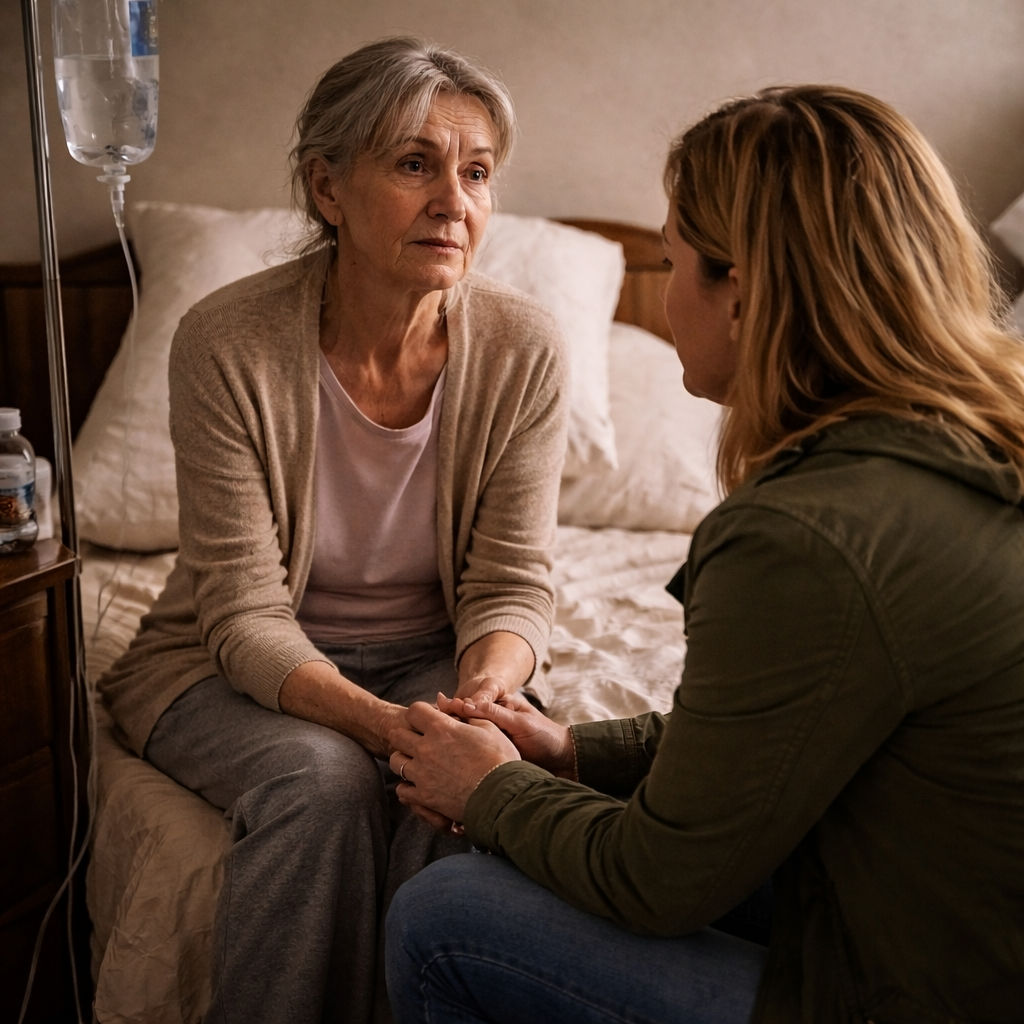
She was sitting on the edge of her bed, thinner than I had ever seen her. Pale. Wrapped in a blanket even though the room was warm.
An IV stand stood beside her.
Not a hospital-grade one — a rented one.
Medication bottles lined the nightstand.
She looked up slowly.
And when she saw me, her face crumpled.
“You weren’t supposed to see me like this,” she whispered.
The truth spilled out over the next hour.
She had been diagnosed with late-stage cancer four months earlier.
Aggressive. Fast-moving.
She hadn’t told me because she didn’t want to “ruin my life.”
“I watched what caregiving did to your grandmother,” she said softly. “I didn’t want you putting everything on hold for me.”
She had hired a private nurse who came during the day. Paid quietly from her savings.
The “renovations” were a lie to keep me away long enough for her to manage it alone.
“I thought I could handle it,” she admitted. “But I’m getting weaker.”
I felt a mix of anger and heartbreak.
“You don’t get to decide that alone,” I said, kneeling in front of her. “I’m your daughter.”
She tried to smile.
“I just wanted you to remember me strong.”
The next months were not easy.
I rearranged my life. Shifted to remote work. Moved into the guest room. Took over the garden.
The nurse still came, but I handled the nights.
We talked more in those weeks than we had in years.
About her childhood. About mistakes she regretted. About fears she had never admitted.
One evening, while I was trimming the overgrown roses, she watched from the window.
“I hated seeing it like that,” she said later. “It felt like everything was slipping.”
“It’s not,” I told her. “I’m here.”
She passed away quietly in early spring.
Not alone.
Her hand was in mine.
After the funeral, I stayed in the house for a while.
I didn’t sell it immediately.
I restored the garden.
Trimmed the hedges. Cleared the weeds. Replanted her favorite roses.
Neighbors started stopping by again.
They told me they had noticed fewer lights on at night but assumed she wanted privacy.
She had hidden her illness from more than just me.
I found a folder in her dresser weeks later.
Inside was a letter.
I’m sorry for lying about the renovations, it began.
I was renovating something — my courage. I didn’t want you to see me afraid.
If you’re reading this, it means you found me anyway. And that makes me proud. It means I raised someone who listens to her instincts.
Thank you for coming.
I keep that letter in the kitchen drawer now.
Sometimes love hides behind pride.
Sometimes strength looks like secrecy.
But I’m grateful I showed up unannounced.
Because what I found wasn’t renovations.
It was a mother who was scared.
And a final chance to be there for her — the way she had always been there for me.