My grandmother passed away three years ago.
She raised me for most of my childhood. While my dad worked long hours and my mom drifted in and out of the picture, Grandma was steady — school lunches, bedtime stories, warm soup when I was sick.
So when she left me her house, no one was surprised.
Except my father.
He didn’t argue at the time. The will was clear. The house was legally transferred to me. I was twenty-seven then, already working full-time, and the house was modest but fully paid off.
It wasn’t about money.
It was about memory.
Recently, my dad remarried.
His new wife, Carla, was polished, outspoken, and very concerned with appearances. Two months after their wedding, Dad showed up at my door with suitcases.
“We’re moving in,” he said casually. “It makes sense. I’m her son. That house should’ve been mine anyway.”
I reminded him gently, “Grandma chose otherwise.”
He waved it off. “Legal technicalities. Family is family.”
Against my better judgment — and partly out of guilt — I let them stay temporarily. They said it would just be until they found a place.
That was my first mistake.
Within weeks, things began to change.
Carla rearranged the living room without asking. She replaced Grandma’s curtains with expensive modern panels. She complained about the old kitchen cabinets and suggested “upgrades.”
Then one afternoon, I came home to find boxes on the porch.
My boxes.
Family photo albums. Grandma’s quilt. My books.
Carla stood in the doorway, arms crossed.
“I live here now,” she said coolly. “This place has to reflect my standards.”
I felt something shift inside me.
“Reflect your standards?” I repeated.
“Yes. It can’t look like a retirement museum forever.”
My father stood behind her — silent.
That silence hurt more than her words.
But I didn’t argue.
I didn’t yell.
I smiled.
Because three years ago, when Grandma signed the house over to me, she’d also given me advice.
“Never put your security in someone else’s hands,” she had said.
So when Dad first mentioned moving in, I quietly met with a lawyer.
The house was solely in my name. No joint ownership. No shared rights. I had also updated the property insurance and installed a security system — cameras included — after a minor break-in scare last year.
Everything was documented.
Including the day Carla threw my belongings outside.
That night, I made a call.
Not to the police.
To my attorney.
The next morning, my father received formal written notice to vacate the property within thirty days.
Carla laughed when she saw the envelope.
“She wouldn’t dare.”
But I had already dared.
I had copies of footage showing them disposing of my property. I had documentation proving sole ownership. I had proof they had contributed nothing financially to the home.
Thirty days passed quickly.
They didn’t believe I would follow through — until the official eviction paperwork arrived.
The night before they were scheduled to leave, Carla was in the living room discussing “renovation ideas” over the phone.
Then her voice cut off.
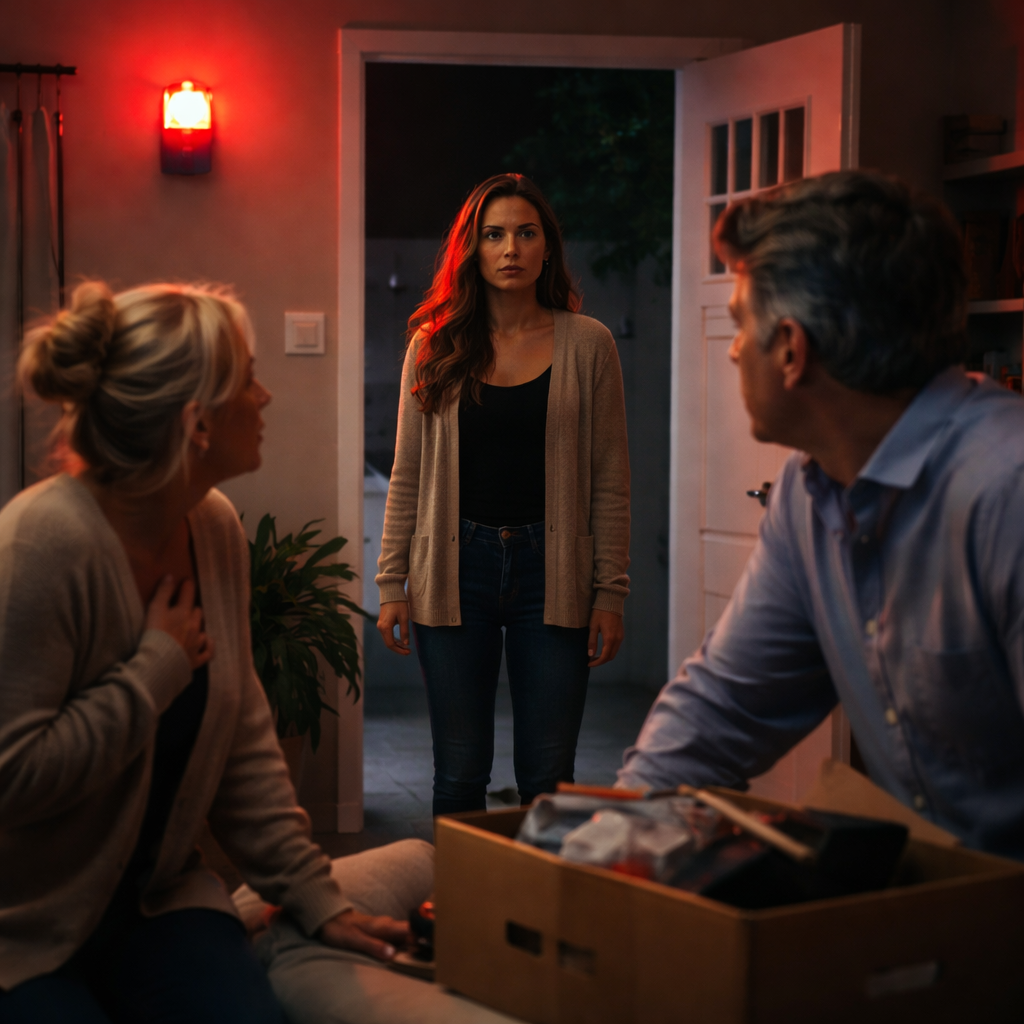
A loud alarm sounded through the house.
The security system had been activated remotely — by me.
Red lights flashed. The recorded voice announced:
“Unauthorized occupancy detected.”
Carla screamed.
My father looked stunned.
I stepped into the doorway calmly.
“I updated the access permissions this morning,” I said. “The system recognizes only registered residents.”
Carla’s face turned pale.
“You did this on purpose!” she shouted.
“No,” I replied evenly. “I protected what’s mine.”
They left the next day.
No dramatic showdown. No revenge speech.
Just suitcases rolling down the porch steps.
A week later, Dad called.
He sounded tired.
“I didn’t think you’d push it that far.”
I answered honestly. “I didn’t think you’d let her treat me like that.”
There was a long silence.
“I’m sorry,” he said quietly.
It wasn’t a perfect apology. But it was something.
Carla never contacted me again.
I restored Grandma’s curtains. Brought her quilt back to the couch. Put the photo albums on the shelf where they belonged.
The house felt like home again.
People sometimes assume I got revenge.
I didn’t.
I enforced boundaries.
There’s a difference.
Grandma didn’t leave me that house because I deserved it more than her son.
She left it to me because she trusted me to protect it.
And sometimes, protection doesn’t look loud.
Sometimes it looks like paperwork, patience, and the quiet confidence of knowing the deed is in your name.
That night Carla screamed because she thought she had taken control.
But the truth was simple:
I never lost it.