My mom died when I was ten.
It was just me and my dad after that. We weren’t perfect, but we were close. He worked long hours, but every Sunday we had pancakes and music blasting in the kitchen. He’d call me his “favorite human.”
When I was fourteen, he remarried.
Cheryl.
She had a polished smile and soft voice in public. At home, she was different. Short-tempered. Critical. Always reminding me that I was “lucky” she was willing to live with someone else’s child.
Dad didn’t see it. Or maybe he didn’t want to.
Five years later, when I was nineteen, Dad died suddenly of a heart attack.
One minute he was complaining about back pain. The next, he was gone.
I barely remember the funeral. I remember holding my guitar case like it was something solid in a world that had turned liquid.
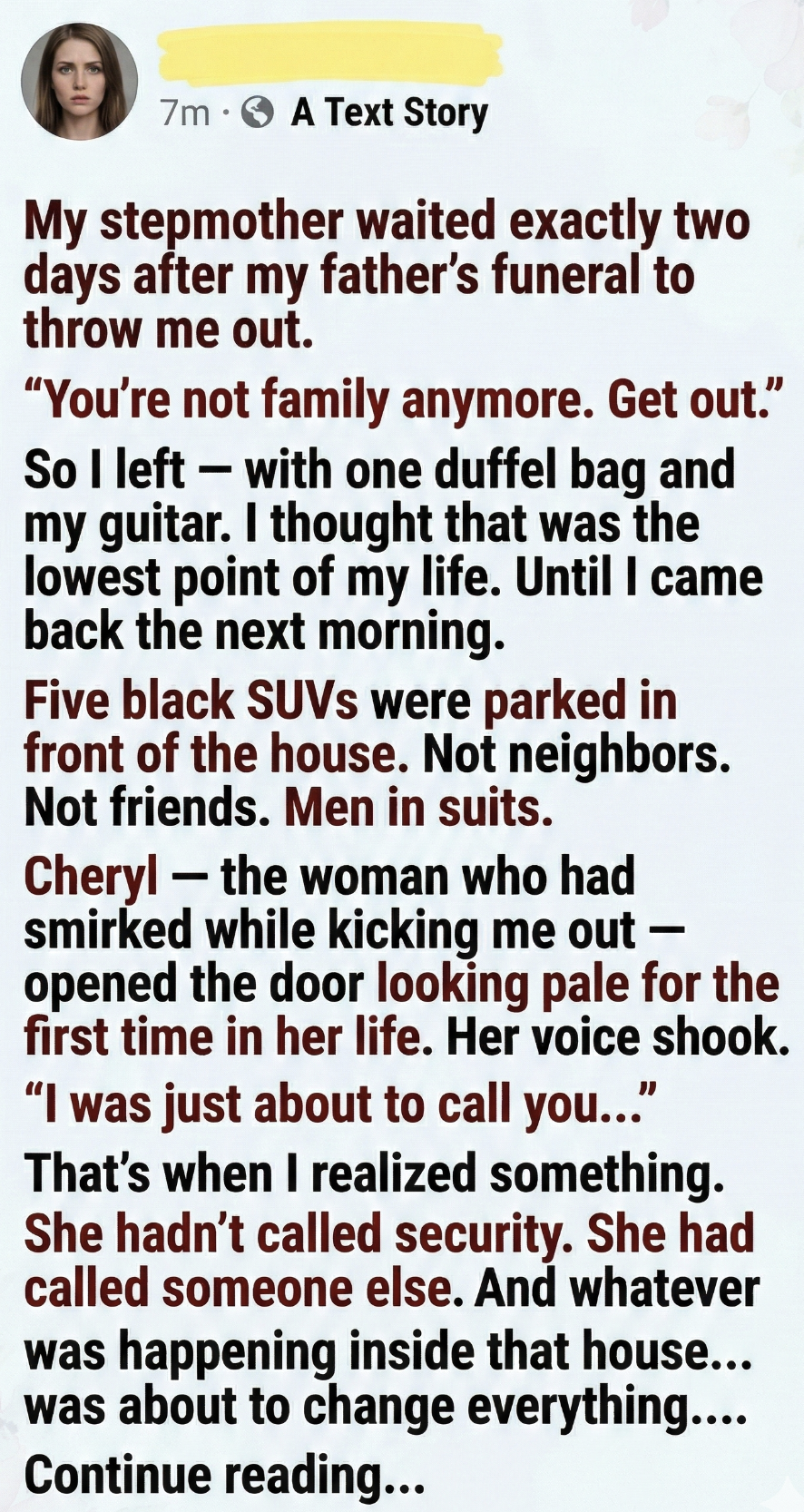
Two days after we buried him, Cheryl stood in the kitchen with her arms crossed.
“You’re not family anymore,” she said flatly. “This house is mine. You need to go.”
I stared at her, waiting for it to be grief talking.
It wasn’t.
By sunset, my clothes were stuffed into a duffel bag. I took my guitar — the one Dad bought me for my sixteenth birthday — and walked out.
I slept on a friend’s couch that night.
The next morning, I realized I’d left some important documents and a small box of my mom’s things in my old room. I went back.
That’s when I saw them.
Five black SUVs lined up in front of the house.
Men in suits stood near the porch. Not police. Not movers.
Corporate.
For a second, I thought Cheryl had called security to keep me out.
But when she opened the door and saw me, her face drained of color.
“Oh,” she said, forcing a smile. “I was just about to call you.”
Behind her, one of the suited men stepped forward.
“Are you Daniel?” he asked.
I nodded slowly.
“My name is Thomas Greene. I was your father’s attorney.”
Attorney?
Cheryl’s head snapped toward him. “What is this?” she demanded.
He ignored her.
“Your father updated his will six months ago,” he said calmly. “You are the primary beneficiary of the property and the majority of his business assets.”
The world went silent.
“What?” Cheryl’s voice cracked.
Mr. Greene continued, “The house was purchased before the marriage. It was never transferred into joint ownership. Legally, it belongs to Daniel.”
I felt like I couldn’t breathe.
Cheryl started talking fast — something about being his wife, about rights, about misunderstandings.
The lawyer simply handed her paperwork.
“Mrs. Cheryl,” he said evenly, “you were left a financial settlement. However, you do not own this property.”
She looked at me like I had betrayed her.
But I hadn’t done anything.
Dad had.
The men in suits weren’t security. They were financial advisors and legal representatives. Dad had built a small but successful logistics company over the years. I knew he did well. I didn’t know how well.
And I didn’t know he had seen what was happening at home.
In a letter the lawyer handed me, Dad wrote:
“I know things haven’t been easy. I see more than you think. I needed to make sure that no matter what happens to me, you’ll always have a place that’s yours.”
My hands shook reading it.
Cheryl had tried to remove me from my own house.
By the end of the week, she had moved out.
I didn’t throw her out the way she threw me out. The lawyer handled everything legally and quietly. She received the settlement Dad left her and relocated to another city.
I stayed.
The first night I slept back in my old room, the house felt different. Quieter. Not heavy anymore.
A few months later, I started college using the education fund Dad had set aside. I kept the house but renovated part of it into a small music studio. My guitar — the one thing I carried out that night — hangs on the wall there.
Sometimes I think about how close I was to believing I had nothing.
If I hadn’t come back that morning, I might have never known.
The black SUVs weren’t there to take something from me.
They were there to give it back.
Cheryl told me I wasn’t family anymore.
But my father made sure I would always have a home.