My mom left when I was five.
I don’t remember the exact day. I remember the silence afterward. The way the house felt bigger. Emptier. My dad told me she “needed space.” Years later, I understood that meant she had chosen a different life — one that didn’t include us.
From then on, it was just me and Dad.
He worked four jobs.
Four.
Morning warehouse shifts. Afternoon delivery driving. Night security at a construction site. On weekends, he fixed neighbors’ appliances for extra cash. I barely saw him awake. When he was home, he looked exhausted — grease under his nails, dark circles under his eyes, always smelling like sweat and motor oil.
As a teenager, I didn’t see sacrifice.
I saw failure.
Other kids had dads who coached soccer, wore clean button-down shirts, and drove nice cars. Mine fell asleep at the dinner table.
I called him a “loser” once.
I was sixteen. Angry. Embarrassed. Cruel.
He didn’t yell. He didn’t defend himself. He just looked at me — not hurt, not angry. Just tired.
“I’m trying,” he said quietly.
I rolled my eyes and walked away.
When I was seventeen, my mom came back.
She showed up in a sleek black car, wearing designer sunglasses and perfume that filled the entire living room. Beside her stood a well-dressed man with a gold watch and polished shoes.
“My husband, Daniel,” she said.
Husband.
She hugged me like we were old friends who had simply lost touch.
She talked about her house in another state. Private schools. Vacations. Opportunity. “You deserve more,” she told me. “You’ve struggled long enough.”
I looked at my dad — still in his work boots, still silent.
And I chose her.
I told myself I was choosing my future.
Dad didn’t argue. He didn’t beg. He just nodded and helped carry my suitcase to the car.
“Call me if you need anything,” he said.
I didn’t.
Life with Mom was shiny.
Big house. Clean sheets. New clothes. A car waiting in the driveway. Daniel paid for everything. I transferred schools. I posted photos online. People commented how “lucky” I was.
Dad never called.
I told myself he was angry. Or maybe ashamed.
Ten weeks passed.
I was back in town for a school break and decided — almost casually — to stop by the old house. Part of me wanted to prove something. That I had “leveled up.” That I was right.
The house looked smaller.
The lawn was overgrown.
My stomach tightened.
I knocked.
No answer.
The door was unlocked.
I stepped inside — and the air felt wrong. Still. Cold.
The furniture was gone.
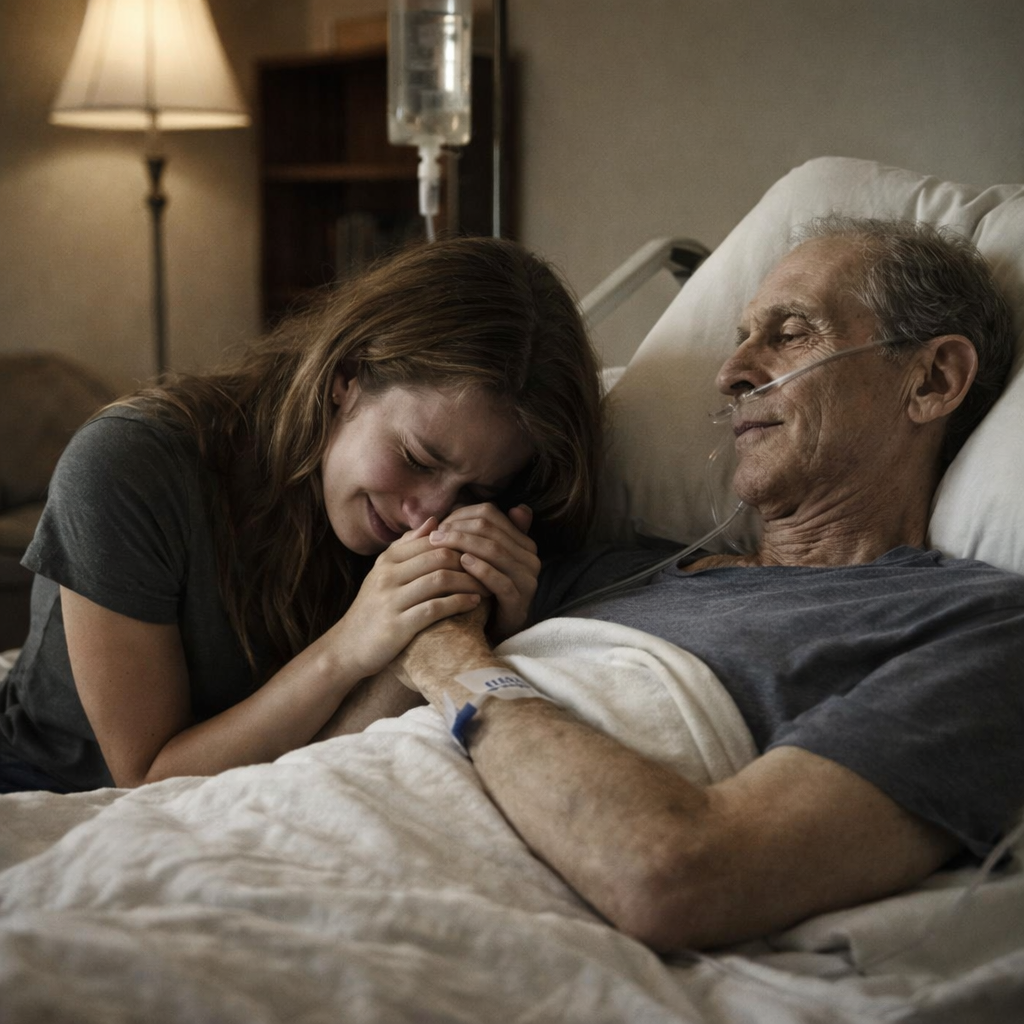
Only a single hospital bed sat in the middle of the living room.
And in it—
My dad.
Thinner. Pale. Tubes running from his arm.
I froze.
A woman standing nearby — a nurse — turned to me gently.
“You must be his daughter,” she said.
My throat closed. “What happened?”
“Stage four pancreatic cancer,” she replied softly. “He was diagnosed months ago.”
Months.
I did the math in my head.
Around the time my mom came back.
“He refused aggressive treatment,” she continued. “Said he needed to keep working as long as possible.”
My legs nearly gave out.
He had worked four jobs not because he was a failure.
Because he was dying.
The nurse handed me a folder.
Inside were bank statements. Savings accounts. Insurance paperwork.
Every extra dollar he earned had been placed into a college fund.
For me.
He had been preparing for my future — knowing he wouldn’t be in it.
I walked to his bedside. His eyes opened slowly.
When he saw me, he smiled.
Not angry.
Not resentful.
Just relieved.
“You came,” he whispered.
I broke.
“I’m so sorry,” I sobbed. “I didn’t know. I didn’t understand.”
He squeezed my hand weakly.
“I didn’t want you to stay out of guilt,” he said. “You deserved a chance at something easier.”
That was why he hadn’t called.
He didn’t want to hold me back.
I stayed that night.
And the next.
Two weeks later, he passed away quietly while I was holding his hand.
After the funeral, I went back to my mom’s house.
It didn’t feel shiny anymore.
It felt hollow.
I realized something no one tells you at seventeen:
Money can upgrade your life.
But it can’t replace the person who sacrificed everything for you.
I used the college fund he built with his dying hands.
I graduated.
But every achievement carries a shadow — the memory of the man I once called a loser.
He wasn’t a loser.
He was the strongest person I’ve ever known.
And I learned too late that the richest life I ever had was the one where he was still alive.