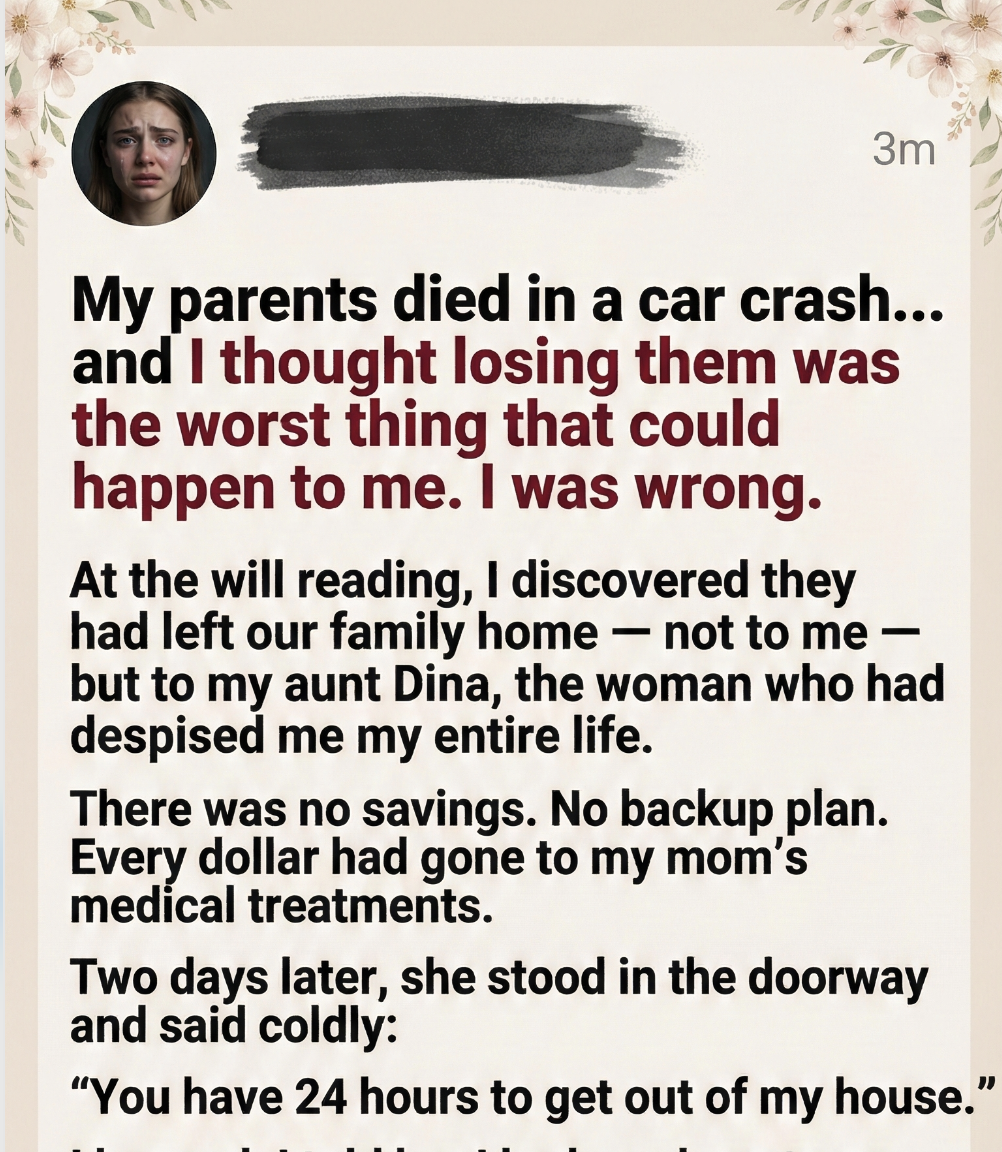
When my parents died in a car crash, the world didn’t just crack — it shattered.
I was 23.
They were everything to me.
The weeks after the funeral passed in a fog of paperwork, condolences, and silence. I barely slept. I barely ate. The house felt empty in a way that echoed.
Then came the will reading.
I assumed the house would be mine. It wasn’t about greed. It was about stability. It was the only home I had ever known.
Instead, the lawyer cleared his throat and said:
“The family residence will transfer to Dina Morales.”
My father’s sister.
The woman who had never liked me.
I stared at him, waiting for the rest.
There was none.
The savings were gone. Every dollar had been used for my mother’s cancer treatments.
I didn’t blame them. I would have given everything too.
But I was left with nothing.
Two days later, Aunt Dina showed up with a copy of the deed.
“You have one day to get out of my house.”
I begged her to let me stay at least a few weeks.
She shrugged.
“I didn’t ask for this burden.”
That night, while she watched television in the living room like she owned the place, I packed my childhood into boxes.
My father’s books.
My mother’s dishes.
Photographs.
I cried quietly so she wouldn’t hear me.
The next morning, I carried my suitcases outside.
And that’s when I saw it.
A black limousine parked in front of the house.
I assumed it belonged to a neighbor.
Until the back door opened.
And a man stepped out.
He was older — mid-50s, well dressed, serious but kind eyes.
“Are you Daniel Morales?” he asked.
My throat tightened.
“Yes.”
“My name is Mr. Herrera. I worked with your father for over twenty years.”
I didn’t understand.
He gestured toward the car.
“Your father asked me to contact you if anything ever happened to him.”
My legs felt weak.
He explained that my father had quietly invested in a small startup years ago — a logistics company started by Mr. Herrera’s son.
At the time, it was a risk. A long shot.
But it had grown.
A lot.
“He didn’t want to put it in the will,” Mr. Herrera said. “He was waiting for it to mature. He told me if something ever happened unexpectedly… it was all for you.”
I thought I misheard him.
“All?” I asked.
Your father’s shares were now worth enough to set you up comfortably — not billionaire-level, but life-changing. Enough to pay for school. Enough to buy a home. Enough to breathe.
I sat on my suitcase and cried.
Not because of the money.
Because my father had thought ahead.
Because even in death, he had protected me.
Aunt Dina stood in the doorway watching the entire conversation.
Her expression shifted from irritation… to confusion… to realization.
She stepped outside quickly.
“What’s going on?” she demanded.
Mr. Herrera calmly handed me an envelope — documents, account information, a letter.
My father’s handwriting was on the front.
“For my son. When he needs it most.”
Dina’s voice softened suddenly.
“Well… maybe we rushed things,” she said awkwardly.
I looked at her for a long moment.
The house suddenly didn’t feel important anymore.
I wasn’t powerless.
I wasn’t abandoned.
I stood up.
“No,” I said gently. “You didn’t rush. You showed me exactly who you are.”
I picked up my suitcases.
I didn’t argue about the house.
I didn’t ask to stay.
I got into that limousine and left.
Two years later, I bought my own home.
Smaller than my childhood house — but it was mine.
I finished my master’s degree using the funds my father left behind.
I visit my parents’ grave every month.
And every time, I whisper:
“You didn’t leave me nothing.
You left me strength.”
As for Aunt Dina?
She tried to reconnect once.
I wished her well.
But some doors, once closed, stay closed.
And sometimes, the worst day of your life is just the beginning of something stronger.