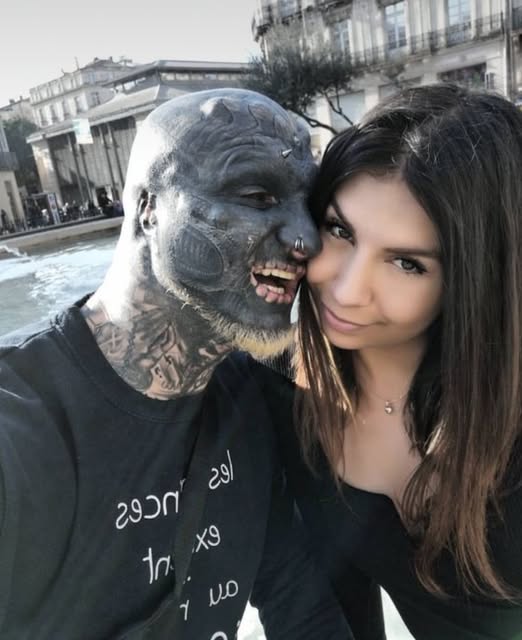
He never intended to become a public spectacle.
Yet the moment he reentered everyday life after altering his appearance, attention followed him everywhere. Eyes lingered. Whispers surfaced.
Reactions ranged from fascination to discomfort to open disapproval. At thirty-five, he found himself standing at an unexpected crossroads—between personal authenticity and a society unsure how to respond.
Modern culture often champions self-expression. From bold fashion statements to tattoos and piercings, people are increasingly encouraged to present themselves in ways that reflect their inner identities.
In theory, individuality is celebrated. In practice, acceptance has limits—especially when personal choices challenge deeply ingrained ideas of what it means to look “human.”

A French man in his mid-thirties has become a focal point of that tension. Through extensive, permanent body modifications designed to give him a distinctly non-human appearance, he has ignited debate across social and public spaces.
His transformation has reportedly affected his daily life, creating barriers to employment and even limiting access to certain venues. His experience raises uncomfortable but necessary questions about how far society’s tolerance truly extends.
He describes his transformation not as rebellion, but as an evolving artistic exploration of the body. Over several years, he underwent numerous procedures—some performed outside France due to legal constraints.
Speaking in interviews with Channel 4 and on Club 113, he explained that his motivation came from curiosity and intention, not a desire to provoke outrage. Each modification, he says, was carefully considered, part of a long-term vision rather than an impulsive act.
Away from public scrutiny, his personal relationships tell a more layered story.
While his family initially struggled to understand his choices, support gradually replaced shock. He has also found connection with model and tattoo artist Melina Shakur, whose shared appreciation for body art reflects a space of mutual understanding. More recently, he has spoken openly on Instagram about slowing down, focusing on the present, and reassessing aspects of his transformation—suggesting reflection and maturity rather than regret.
At its core, his story is not about shock value, but about boundaries—where personal freedom meets collective comfort. His appearance forces society to confront its own contradictions: celebrating individuality while resisting expressions that feel unfamiliar or unsettling. Whether viewed with admiration, curiosity, or criticism, his journey underscores the idea that fulfillment and identity cannot be standardized.
Conclusion
This man’s transformation is not merely about physical change—it is a living conversation about autonomy, tolerance, and the courage required to live truthfully. His experience challenges us to question where acceptance ends and why. In a world still negotiating how much difference it can hold, his story reminds us that true respect means allowing others the freedom to exist as they choose—even when it pushes us beyond what feels comfortable.