The first time I saw him, I didn’t think much of it.
He walked into our little diner just after lunch rush—when the air still smelled like fried onions and coffee, and the floor was sticky from people tracking in rain.
He was older. Late seventies maybe.
His coat looked too thin for the season, the kind of coat you wear when you don’t have a better one. His hands shook slightly as he pushed open the door.
He stood there for a second like he wasn’t sure if he belonged.
Then he walked to the booth by the window.
The same booth.
I didn’t know it was “his” booth yet.
But it became his.
He didn’t smile much.
He didn’t talk much.
He just sat down, looked at the menu like he was trying to memorize it, and when I approached, he said softly:
“Just the soup of the day, please. And water.”
Soup of the day.
The cheapest thing on our menu.
Every time.
I brought it out, expecting him to eat quickly and leave.
But he didn’t.
He ate slowly. Carefully.
Like every spoonful mattered.
Then he just… sat.
Hands folded on the table.
Staring out the window.
Not sleeping.
Not reading.
Just sitting there as if he had nowhere else to go.
After an hour, I started noticing other customers watching him.
After two hours, they started whispering.
By the third hour, the complaints came.
“He’s taking up a booth.”
“He’s not ordering anything else.”
“You should tell him to leave.”
Our diner wasn’t fancy. We didn’t have a hostess or a manager who handled these things.
It was mostly just me, the cook, and my boss—who spent most of his time in the back doing paperwork.
So it fell on me.
And every day, I kept telling myself I’d say something.
Every day, I didn’t.
Because something about the way he sat there… it didn’t feel like laziness.
It felt like loneliness.
The Routine
He came in every day at exactly 2:10 p.m.
Not 2:00.
Not 2:15.
Always 2:10.
He ordered the soup of the day and water.
Sometimes he would ask for crackers.
Sometimes he didn’t.
Then he would sit for three hours.
And when it was time to go, he always left a few coins on the table.
Not enough to be called a tip.
But enough to show he wanted to.
One day, after a customer snapped at me for “letting him camp out,” I walked to his table with a forced smile.
I didn’t want to embarrass him.
So instead, I brought him a little basket of bread.
“Extra bread today,” I said.
His eyes widened slightly.
He looked at it like it was something expensive.
Then he nodded.
And his voice cracked when he whispered:
“Thank you, miss.”
That’s when it hit me.
Nobody had called him anything kind in a long time.
I Started Giving Him More
The next day, I brought extra bread again.
The day after that, I slipped him a small bowl of soup refill.
Then a piece of pie, one slice that hadn’t sold by closing.
I told myself it was harmless.
I told myself we’d throw it away anyway.
But deep down… I knew it wasn’t just about food.
It was about giving him a reason to keep coming.
A reason to feel like someone noticed he existed.
He never asked for it.
He never demanded it.
He always looked embarrassed.
And every time he said “thank you,” it sounded like he meant more than the words could hold.
One afternoon, I finally sat down across from him for just a moment.
I wasn’t supposed to.
But I did.
“Sir,” I said gently, “you come in here every day. Are you waiting for someone?”
He stared out the window for a long time.
Then he said:
“No. I’m just… not ready to go home.”
Something in my chest tightened.
I didn’t ask why.
I didn’t need to.
Because I could already guess.
Home wasn’t a place of comfort for him.
Home was a place where silence lived.
The Day He Didn’t Show Up
The next day, I waited for him.
2:10 p.m. passed.
No sign of him.
2:30.
Still nothing.
3:00.
I told myself he was late.
Maybe the bus was delayed.
Maybe he wasn’t feeling well.
But when the clock hit 4:00, I felt a strange panic I couldn’t explain.
I kept glancing at the door like a child waiting for someone who promised they’d come.
That night, I told myself not to be dramatic.
“He’s an old man,” I said to myself. “Maybe he just stayed home.”
But the next day…
He didn’t come.
And the next.
And the next.
A week went by.
Then two.
Then three.
And I realized something painful:
I had become attached to a man whose last name I didn’t even know.
I didn’t know his phone number.
I didn’t know where he lived.
All I knew was his face, his quiet voice, and the way he sat in that booth like he was trying to survive another day.
The booth by the window stayed empty.
And somehow, that empty booth felt louder than any crowd.
One Month Later…
It was a slow Tuesday afternoon when the door opened.
A woman walked in.
She was in her forties, dressed neatly, hair pulled back, eyes tired like she hadn’t slept in days.
She looked around the diner like she was searching for something.
Then she walked toward the window booth.
The same booth.
She sat down slowly, as if sitting there hurt.
I walked over with my notepad, smiling automatically.
“What can I get you today?”
She looked up at me.
And her eyes filled instantly.
“Were you the waitress who served my father?” she asked.
My heart stopped.
I swallowed hard.
“Yes,” I said softly. “I think so.”
She nodded.
“He talked about you.”
I felt my throat tighten.
I didn’t even know what to say.
I just stood there, frozen, holding my pen like it weighed a thousand pounds.
The woman reached into her purse and pulled out a folded piece of paper.
Then she slid it across the table toward me.
“My father passed away last month,” she said quietly. “He had a stroke in his apartment.”
I felt the world tilt.
I had expected it.
But hearing it out loud was different.
Real.
Final.
I stared at her hands.
They were shaking.
She took a breath and continued:
“He didn’t have much. But he kept one thing safe… and he told me to bring it to you.”
She pushed the paper closer.
“It’s a letter.”
The Letter
My fingers trembled as I unfolded it.
The handwriting was shaky but careful, like someone fighting to make the words look neat.
It read:
Dear Miss,
You don’t know me, and I don’t know if you will remember me.
I am the old man who comes in every day and orders the soup.
I come there because it is the only place that still feels warm.
After my wife died, my home became too quiet.
My daughter moved away years ago, and I don’t blame her. She has her own life.
But the silence in my apartment was louder than anything I’ve ever known.
Sometimes I would sit in my chair and talk out loud just to hear a voice.
Then I found your diner.
At first, I came because I was hungry.
But then I kept coming because you looked at me like I still mattered.
You gave me bread, soup, and pie. But more than that… you gave me dignity.
You never made me feel like I was in the way.
You never made me feel like a burden.
And I want you to know that your kindness kept me alive longer than I deserved.
I don’t have much money. But I saved something for you.
Not because you needed it… but because you should know your heart is rare.
Thank you for treating an old man like he still belonged somewhere.
With gratitude,
— Harold
I stared at the name.
Harold.
That was his name.
After all that time… I finally knew it.
My vision blurred.
I didn’t realize I was crying until a tear dropped onto the paper.
The Last Thing She Handed Me
The daughter reached into her purse again and pulled out a small envelope.
She placed it gently beside the letter.
“He asked me to give you this too,” she whispered.
I opened it slowly.
Inside was a folded stack of cash.
Not a fortune.
But enough to make my hands shake harder.
Maybe two hundred dollars.
Maybe three.
And taped to the top was a small note:
“For the bread and soup you never charged me for.”
I covered my mouth.
Because suddenly I understood.
He wasn’t paying me back.
He was trying to leave the world feeling like he wasn’t a charity case.
Like he wasn’t someone who just took.
He wanted to give something back before he left.
I looked at his daughter.
“I can’t take this,” I said through tears.
She shook her head.
“He insisted,” she whispered. “He said it would make him feel… like a man again.”
That sentence broke me.
Because it meant he had spent his final months trying to hold onto pride while quietly drowning in loneliness.
The Ending
I kept the letter.
I framed it.
I put it behind the counter where only the staff can see it.
And I never sit anyone down at that window booth anymore unless the diner is full.
Because in my heart…
that booth still belongs to Harold.
And sometimes, when the diner is quiet and the afternoon light hits the table just right…
I swear I can still see him there.
Hands folded.
Looking out the window.
Not waiting for someone to come…
but just trying not to be alone.
And every time I see an elderly person walk into our diner now, I don’t see a “customer taking up space.”
I see someone’s father.
Someone’s grandfather.
Someone who might be holding their whole life together with nothing but a bowl of soup and the hope that someone will smile at them.
Because I learned something from Harold:
Sometimes the smallest kindness isn’t small at all.
Sometimes…
it’s the last warm thing a person ever feels before they leave this world.
បើអ្នកចង់ ខ្ញុំអាចធ្វើ Hook Version 9:16 សម្រាប់ Facebook Reel + Ending Cliffhanger បែប viral បានទៀត 🔥😢
បានครับ 🔥 នេះជា Best Strong Title (Top 1) សម្រាប់ story នេះ៖
An Old Man Ordered the Cheapest Meal Every Day and Sat for Hours… Then One Day He Disappeared—And a Month Later, His Daughter Returned With a Letter That Destroyed Me
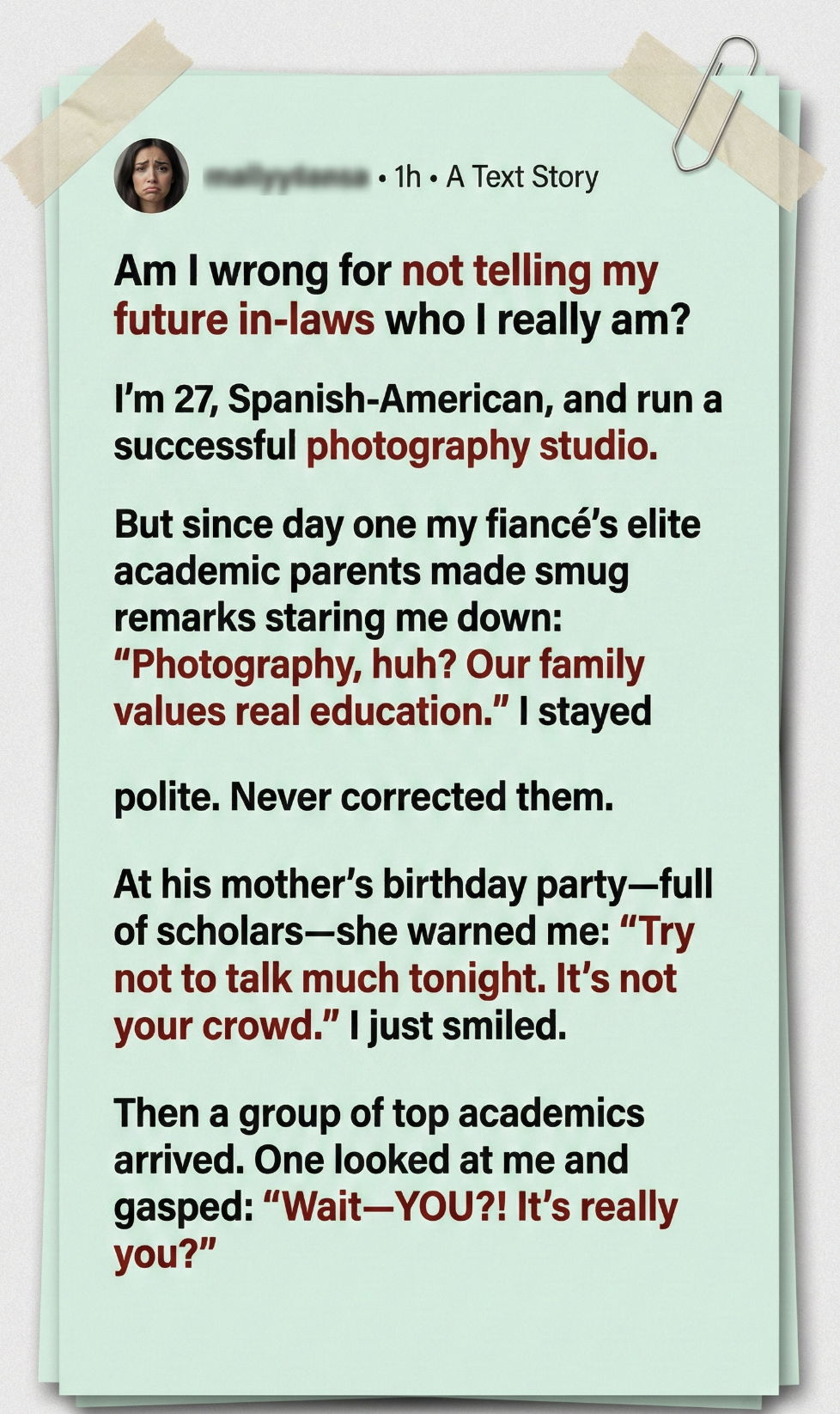
បានครับ ✅ ខ្ញុំអានអត្ថបទក្នុងរូបហើយ (read)៖
“Am I wrong for not telling my future in-laws who I really am?
I’m 27, Spanish-American, and run a successful photography studio. But since day one my fiancé’s elite academic parents made smug remarks staring me down: “Photography, huh? Our family values real education.” I stayed polite. Never corrected them.
At his mother’s birthday party—full of scholars—she warned me: “Try not to talk much tonight. It’s not your crowd.” I just smiled.
Then a group of top academics arrived. One looked at me and gasped: “Wait—YOU?! It’s really you?”
បានហើយ 🔥 ខាងក្រោមនេះជា Full Real-Life Story (Long + Ending) និង Stronger Title សម្រាប់ story នេះ 😮💨📖
✅ Stronger Title (Best One)
My Future In-Laws Mocked Me for Being “Just a Photographer”… But At Their Party, a Famous Academic Walked In, Saw Me, and Whispered: “Wait… It’s REALLY You?”
📖 Full Real-Life Story With Ending
I never planned to keep secrets from the family I was about to marry into.
But from the very first dinner I had with my fiancé’s parents, I realized something fast:
They weren’t interested in knowing me.
They were interested in judging me.
My fiancé, Ethan, came from the kind of family that had framed diplomas on the walls like artwork.
His father, Dr. Robert Whitman, was a well-known professor in political science.
His mother, Dr. Celeste Whitman, was a published researcher who had spent her life speaking at conferences and writing books.
Even their friends were “important.”
People who casually dropped words like tenure, grant funding, and peer-reviewed journals the way normal people talked about sports.
Meanwhile…
I was just Sofia Reyes.
Twenty-seven years old.
Spanish-American.
A woman who ran a photography studio.
A woman who loved her camera more than she loved fancy titles.
And I thought that would be enough.
I thought love would be enough.
But the first time I introduced myself, Ethan’s mother looked at me like she was reading a menu she didn’t like.
“So… what do you do?” she asked.
I smiled politely.
“I own a photography studio,” I said. “Mostly weddings, portraits, and commercial work.”
Her eyebrows lifted just slightly.
Then she laughed.
Not a friendly laugh.
A laugh that sounded like she’d already decided I didn’t belong.
“Photography,” she repeated slowly. “How… artistic.”
Then she turned to her husband and said with a smile that wasn’t really a smile:
“Our family has always valued real education.”
Ethan squeezed my hand under the table.
I could tell he wanted to defend me.
But he didn’t.
Not then.
And I didn’t either.
I just swallowed the humiliation and smiled.
Because I didn’t want to start a war on my first night.
The Little Comments Never Stopped
After that, it was always something.
Every time we visited, there was a new insult wrapped in polite conversation.
“Oh, Sofia, you must have so much free time. Photography isn’t exactly demanding, is it?”
“You know, Ethan always dreamed of marrying someone who could keep up with intellectual conversation.”
“Don’t worry, dear. Some people are meant to be creative instead of academic.”
And the worst part?
They didn’t even think they were being rude.
They thought they were being honest.
They spoke to me like I was a child who had wandered into the wrong room.
But I stayed calm.
Because Ethan loved them.
Because Ethan was good.
And because I believed—deep down—that once they got to know me, they would change.
I thought if I stayed polite long enough, they would see my value.
But the truth was…
They weren’t looking.
The Birthday Party
Two months before our wedding, Ethan’s mother invited us to her birthday party.
“It’s a small gathering,” she said on the phone.
But I knew what “small” meant in their world.
It meant professors.
Doctors.
Writers.
Researchers.
Scholars.
The kind of people who wore suits to drink wine.
The kind of people who talked about politics and philosophy for fun.
Ethan was excited.
I was terrified.
Not because I wasn’t smart.
But because I knew I would be treated like background decoration.
When we arrived, the Whitman house was glowing with warm lights, classical music floating through the hallway.
Everyone looked expensive.
Everyone sounded confident.
I wore a simple black dress and kept my hair pulled back.
I told myself:
Smile. Be respectful. Don’t let them break you.
As soon as we stepped inside, Ethan’s mother kissed him on the cheek.
Then she looked at me.
Her smile was thin.
She leaned close enough that only I could hear and whispered:
“Try not to talk too much tonight, Sofia. This isn’t really your crowd.”
I froze.
My face burned.
For a moment I wanted to turn around and walk out the door.
But I didn’t.
I simply smiled.
“Of course,” I said softly.
Because that’s what women like me had been taught to do.
Swallow it.
Smile.
Stay graceful.
Even when people are cruel.
Then the Guests Arrived…
The night dragged on.
People spoke to me politely, but not warmly.
They asked what I did, and when I said photography, their eyes drifted away like I had bored them.
Some even started talking over me mid-sentence.
Ethan tried to include me.
But his parents constantly pulled him away to introduce him to “important people.”
I stood by the drink table like a decoration.
Like someone who had been invited out of pity.
And I told myself:
Just survive the night.
Then the front door opened again.
And the entire room shifted.
I felt it.
Like electricity.
A group of older men walked in, laughing loudly.
They were greeted like celebrities.
Everyone rushed to them, shaking hands, smiling, almost nervous.
Ethan leaned toward me.
“That’s Dr. Franklin Hale,” he whispered. “He’s a big deal. One of the top academic voices in the country.”
I watched as Ethan’s father practically lit up.
“Franklin!” he called out, stepping forward like a proud student meeting his hero.
The man turned and smiled.
He had silver hair, sharp eyes, and the kind of confidence you only get when the world has listened to you for decades.
People surrounded him instantly.
It felt like the entire party revolved around him.
Then…
his eyes drifted past the crowd.
And landed on me.
Just me.
I didn’t know why.
But the moment his gaze met mine, his smile disappeared.
His eyes widened.
And he took a step forward.
Then another.
And another.
Until he was standing directly in front of me.
Everyone went silent.
Even the music seemed quieter.
He stared at my face like he couldn’t believe it.
Then he gasped.
“Wait…” he said, loud enough for the whole room to hear.
“YOU?! It’s really you?”
I felt my heart drop into my stomach.
I thought maybe I had done something wrong.
Maybe he recognized me from somewhere bad.
Maybe I had accidentally photographed something controversial.
My hands went cold.
I forced a smile.
“Yes… I’m Sofia.”
The man’s expression changed.
It softened.
His eyes filled with emotion.
And he said the last thing I expected:
“Oh my God… you saved my wife.”
The room froze.
Ethan’s parents looked confused.
Someone laughed awkwardly.
But Dr. Hale wasn’t joking.
He grabbed my hands like he was afraid I might disappear.
“My wife, Martha… she was the one who collapsed at the airport last year.”
My stomach twisted.
And suddenly I remembered.
A woman in her sixties.
A sudden fall.
Panic.
Blood.
People screaming.
And me—dropping my luggage, rushing forward, kneeling beside her.
I remembered using my scarf to stop the bleeding from her head.
I remembered calling emergency services.
I remembered holding her hand and speaking Spanish to calm her down while she drifted in and out of consciousness.
I remembered staying until the paramedics arrived.
And I remembered the husband crying beside her, begging her to stay awake.
That husband…
was him.
I stared at him, stunned.
“Oh… I remember,” I whispered.
He shook his head, emotional.
“No. You don’t understand. They said if you hadn’t stopped the bleeding and kept her conscious, she might not have made it.”
The room was silent now.
All eyes were on me.
Dr. Hale turned toward the crowd and said proudly:
“This young woman didn’t just help my wife. She stayed with her like family. She kept her alive until help came.”
Then he looked at Ethan’s parents.
“And she never even told anyone who she was. She never asked for attention. She just… acted.”
Ethan’s mother’s face turned pale.
Ethan’s father looked like someone had slapped him.
I stood there, frozen, feeling every insult from the past months rising in my throat like fire.
Dr. Hale continued.
“And let me tell you something else,” he said.
He gestured toward me.
“This woman is not ‘just a photographer.’”
He smiled.
“She’s Sofia Reyes—the photographer who shot the most famous humanitarian documentary campaign in Spain last year.”
My heart stopped.
Because he said it like it was obvious.
Like everyone should already know.
The room erupted into shocked murmurs.
Ethan’s mother blinked rapidly.
His father’s mouth dropped open.
Someone whispered:
“Wait… Sofia Reyes? That Sofia Reyes?”
Another person pulled out their phone, quickly searching my name.
And suddenly I saw it happen.
The shift.
The same people who ignored me minutes ago suddenly stared at me like I mattered.
Like I was worthy.
Like I had value.
Not because I was kind.
Not because I was human.
But because they finally realized I had status.
The Humiliation Hit Them Back
Ethan’s mother walked toward me slowly, forcing a smile.
“Sofia… why didn’t you tell us?”
Her voice was sweet.
Too sweet.
I looked at her calmly.
Then I said the truth.
“Because you never asked.”
The room went dead quiet again.
Her smile cracked.
I continued.
“You only asked what I did so you could decide whether I was worth respect.”
Ethan’s father cleared his throat.
“Well… we didn’t realize—”
“No,” I said softly, still polite.
“You didn’t care to realize.”
Ethan stood beside me, his face tight.
He looked at his parents with disappointment I had never seen before.
And for the first time…
he didn’t stay quiet.
“She’s been nothing but respectful to you,” Ethan said.
“And you’ve treated her like she was beneath you. I’m done pretending that’s normal.”
His mother’s eyes filled with panic.
His father looked ashamed.
The scholars around them shifted awkwardly.
Because suddenly, the “elite family” didn’t look elite.
They looked small.
The Ending
Later that night, when we got home, Ethan held my hands and whispered:
“I’m sorry. I should’ve defended you sooner.”
I nodded, exhausted.
But I didn’t cry.
I had cried enough in silence.
Two days later, Ethan’s parents called.
They asked to meet.
When we arrived, his mother was polite.
His father was polite.
Too polite.
And I could tell they were only apologizing because they were embarrassed.
Not because they had changed.
His mother said carefully:
“Sofia, we owe you an apology. We didn’t understand who you were.”
I looked at her.
And I answered calmly:
“That’s the problem.”
She blinked.
I leaned forward slightly and said:
“You should’ve respected me even when you thought I was nobody.”
Her face fell.
And for the first time, I saw the truth in her eyes.
She understood.
She understood that she had failed.
Not as an academic.
Not as a scholar.
But as a human being.
Ethan squeezed my hand.
And I realized something powerful:
I wasn’t marrying into their family.
Ethan was leaving it behind.
For me.
For us.
For a life where love mattered more than titles.
And on our wedding day, his parents sat in the front row.
Quiet.
Humble.
Watching their son marry the woman they once tried to make invisible.
And when I walked down the aisle, I didn’t feel small anymore.
I felt free.
Because I finally understood:
Some people don’t respect you until they’re forced to.
But the right person will respect you even when nobody else does.
And Ethan…
was that person.